
Building spacecraft, exploring planets and bringing kittens home.
A year ago, the first public build of Kitten Space Agency came with prebuilt spacecraft and some very early development tools. Today, it is possible to build a rocket from scratch, dock with another spacecraft, explore on foot and plan a journey beyond the Solar System.
We began developing KSA in mid-2024 and opened the pre-alpha to everyone on 14 November 2025. Since that public launch, we have released more than 115 public versions, from small fixes to updates that have introduced entirely new systems.
Kitten Space Agency is still pre-alpha as we continue to add systems, revisit early work and fix the problems that come from putting it all together. For this anniversary, we want to share what that first year of public development has made possible.
Thank you to our patrons Murasaki, Noé, Rigel Alula, Cesar, Rigel_Proto, Pimiento, tomservo and BigfootMSR, and to everyone who’s contributed to Kitten Space Agency over the past year. Your support helps us keep building a game that everyone can play for free. We’re grateful to have you with us this early in development.
By our rough estimate, more than 130,000 development hours have gone into KSA so far. Community contributions have covered around 2% of the game's real-world development costs, with RocketWerkz funding the rest. Those contributions remain optional, and every contribution helps support the work.
Whether you have contributed, tested a build, reported a problem, made a mod or simply taken a kitten somewhere interesting, thank you for being part of this first year.
One of our first experiments with it was a small orbital mechanics demo. Some of that work ended up powering the sky in Stationeers before we began developing KSA.
Much of the work before the public pre-alpha went into getting the simulation and graphics to run independently. BRUTAL gave us the tools to build both around the needs of a space sim. We could use our own maths library to keep orbital paths stable across the Solar System and build a renderer that could handle entire planets as well as individual spacecraft parts. We’re starting to see those years of work pay off in the game itself.
We’re also celebrating Ahwoo’s first anniversary. Getting a KSA build ready was only part of going public. We needed a way to get it into people’s hands for free and let anyone who wanted to help contribute towards development. Ahwoo gave us both, along with dedicated KSA forums where players can report bugs, ask questions, share mods and show us what they’ve built. That gave us a place to hear directly from players as we worked on the next build.
Special thanks to the BRUTAL and Ahwoo teams whose work make Kitten Space Agency possible.
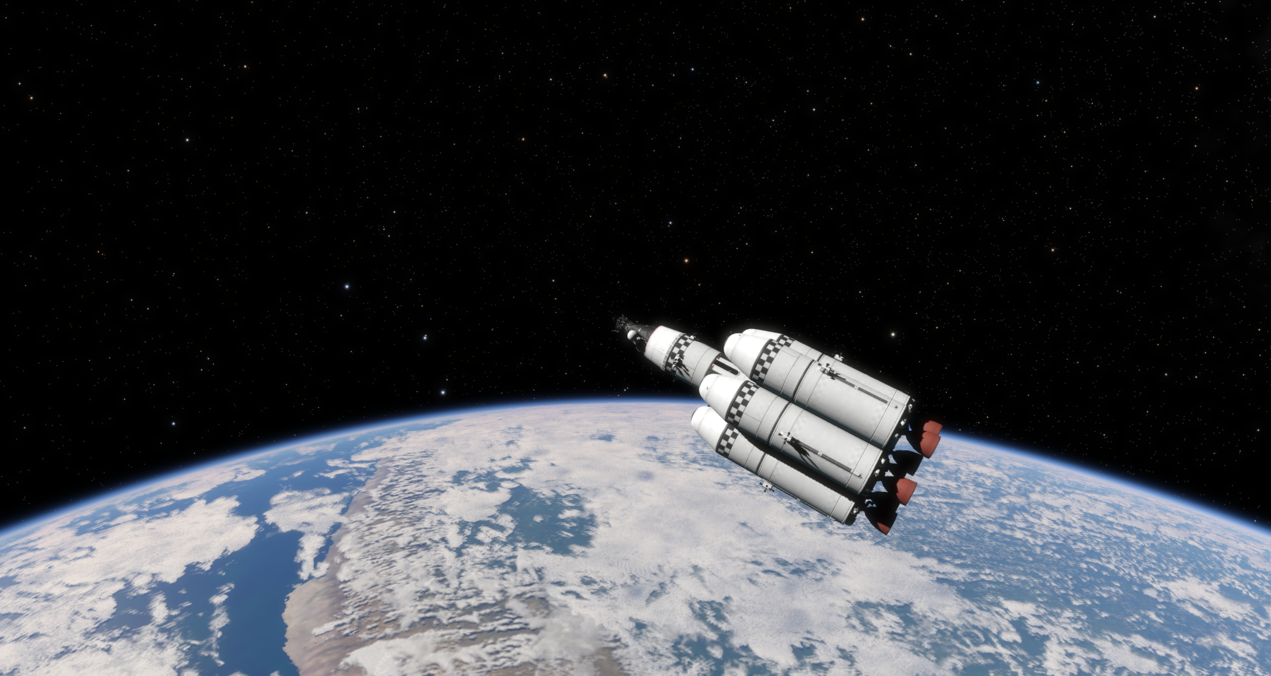
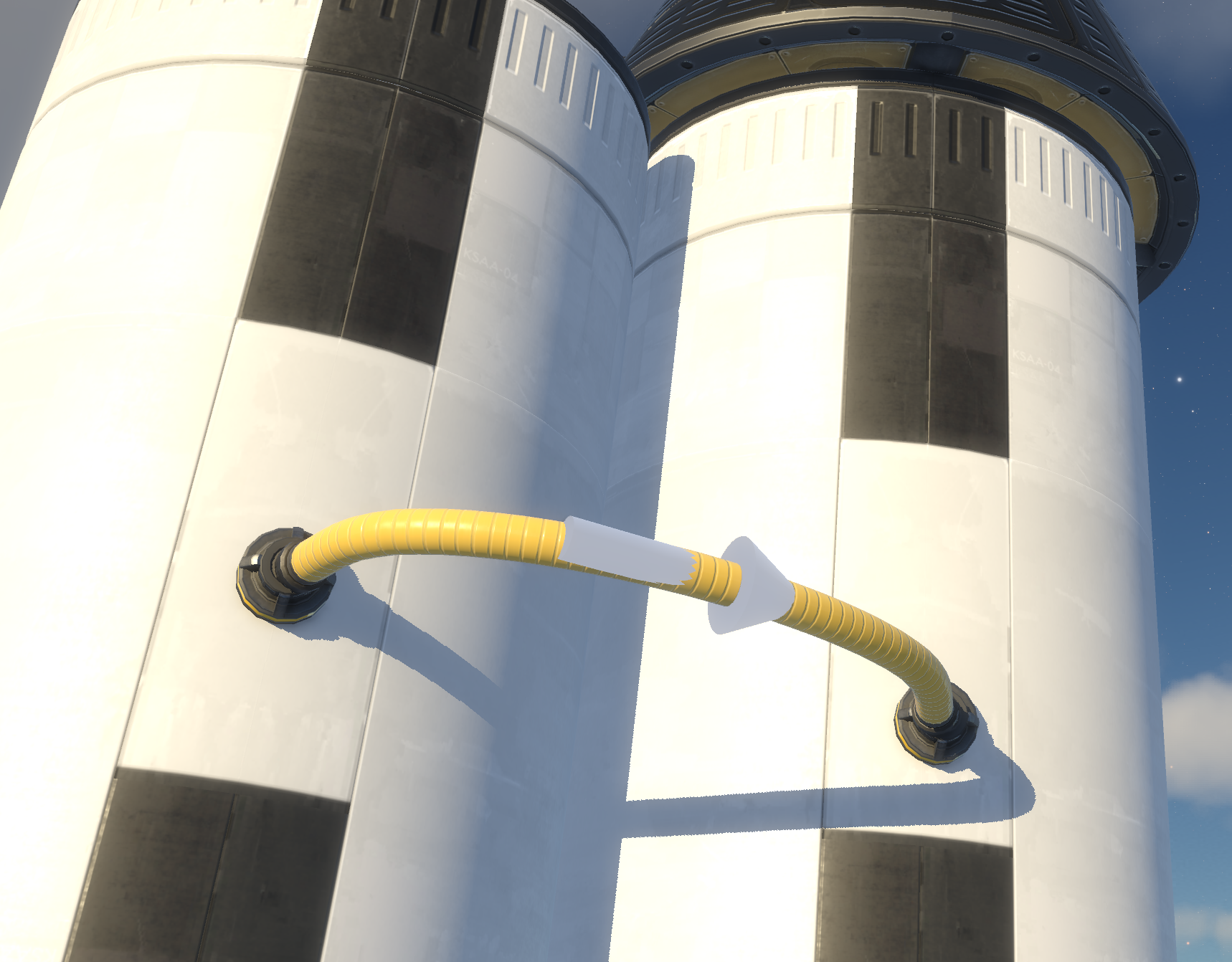
We’ve also built out the systems that make those spacecraft work. Engines now respond to changes in atmospheric pressure, and gimbals let you steer with thrust. Propellant follows the connections between parts, so a pair of boosters can feed a central stage through fuel lines that are severed when the boosters separate. A flow overlay shows which tanks each engine can draw from. Batteries, generators and deployable solar panels that track the Sun give you ways to keep equipment powered in flight.
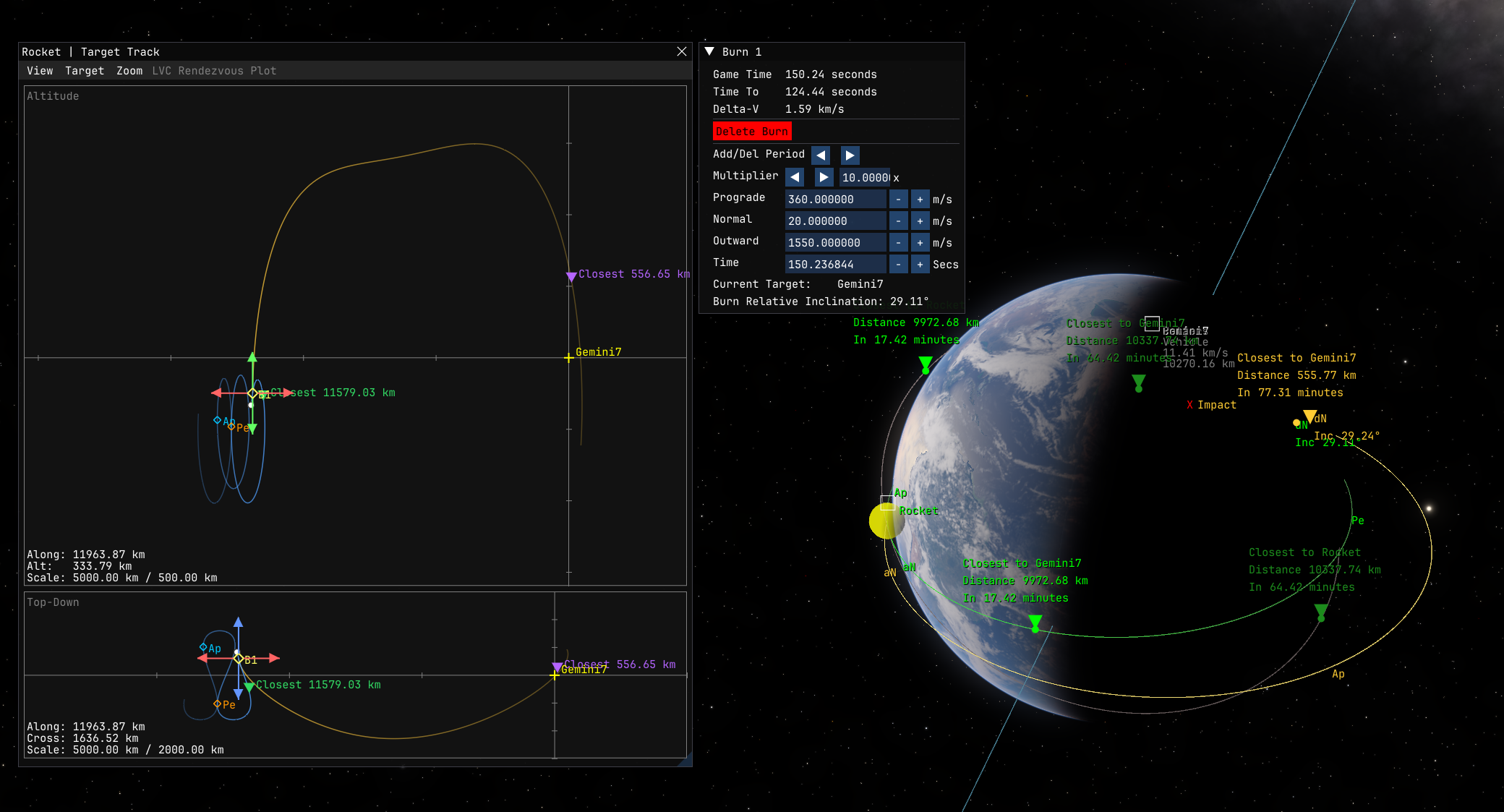
Orbital trajectories and flight planning were already part of the first public build. This year, we have worked on making those paths more useful as spacecraft and their journeys become more complicated.
Adjusting a planned burn changes the predicted path, while closest-approach information helps with working towards an encounter. April's target-tracking window made relative position and velocity easier to understand. Burn editing brought more of that planning into the same window.
Later prediction work accounts for the duration of a burn and changes between stages. A spacecraft keeps moving while its engines fire, so the trajectory needs to reflect the whole manoeuvre and the changing vehicle as stages separate.
Ground tracks have also gained support for planned burns, showing where a route passes over the surface below. Together, these tools make it easier to compare a plan with the flight it is meant to produce.
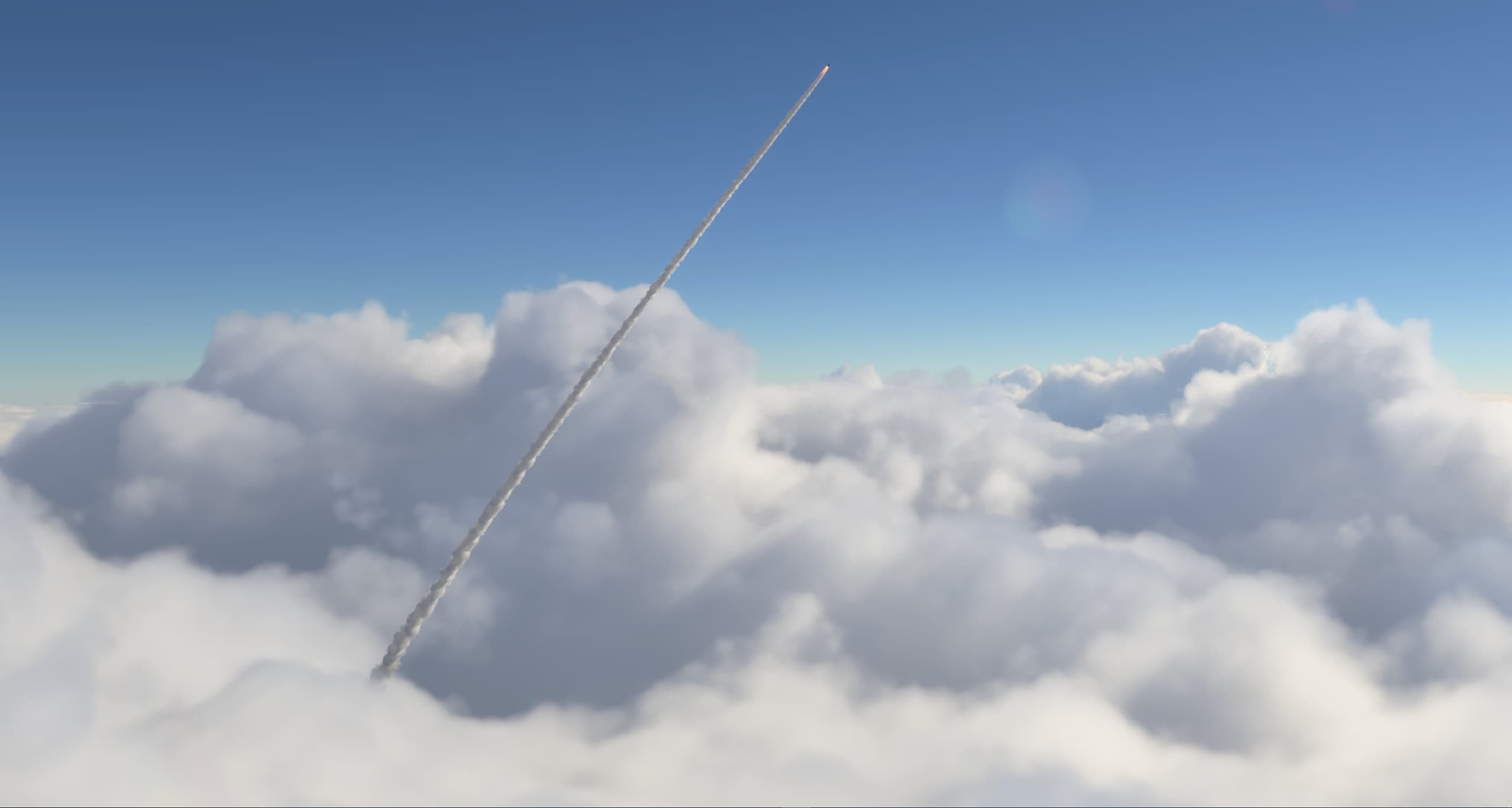
April brought physically driven plume rendering, using gas properties to inform shape and density. Shock cells and Mach diamonds followed, then heat refraction in May. Volumetric trails arrived experimentally in July, with solid rocket boosters providing an early application.
Later updates developed how exhaust responds to movement and airflow, how nearby plumes combine, and how exhaust, clouds and explosions overlap. October added shadows from the trails across the scene. Cloud-shadow work also improved how low-angle light falls across the landscape
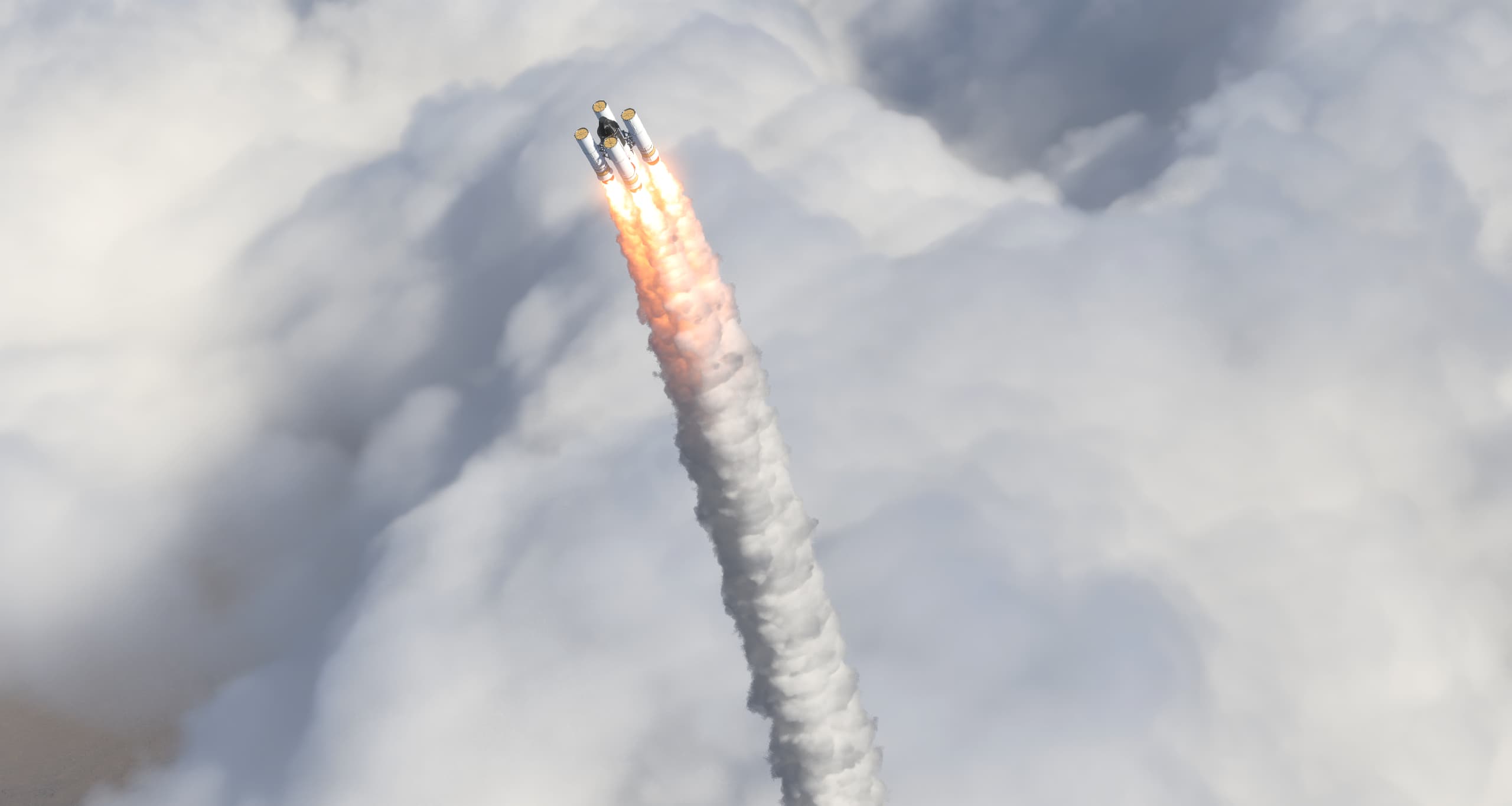
Plumes from several engines can combine as a rocket climbs. Exhaust can overlap with clouds, and trails can cast shadows across the scene. Getting those effects to work together has meant connecting the propulsion simulation with the renderer.
There are still approximations and refinements to work through, however, progress is visible in the changing shape of the exhaust and the trail stretching back towards the launchpad.

Docking itself passed through several stages. March's early implementation joined nearby vehicles through a proximity-based workflow. In June, docking moved to physical contact between ports, followed by further work on how a latch responds to the encounter.
That change depended on a broader improvement to collisions. Nearby vehicles initially interacted through coarse bounding shapes. Fine part colliders then brought contact closer to the actual spacecraft geometry, making the shapes of individual components matter when two craft meet.
The same work affects landing and failure. We addressed contact stability and settling, added whole-vehicle destruction, and then moved to individual part destruction in September. A collision can break a craft into separate pieces. Deformation, explosions and sound give those events a visible and audible result.
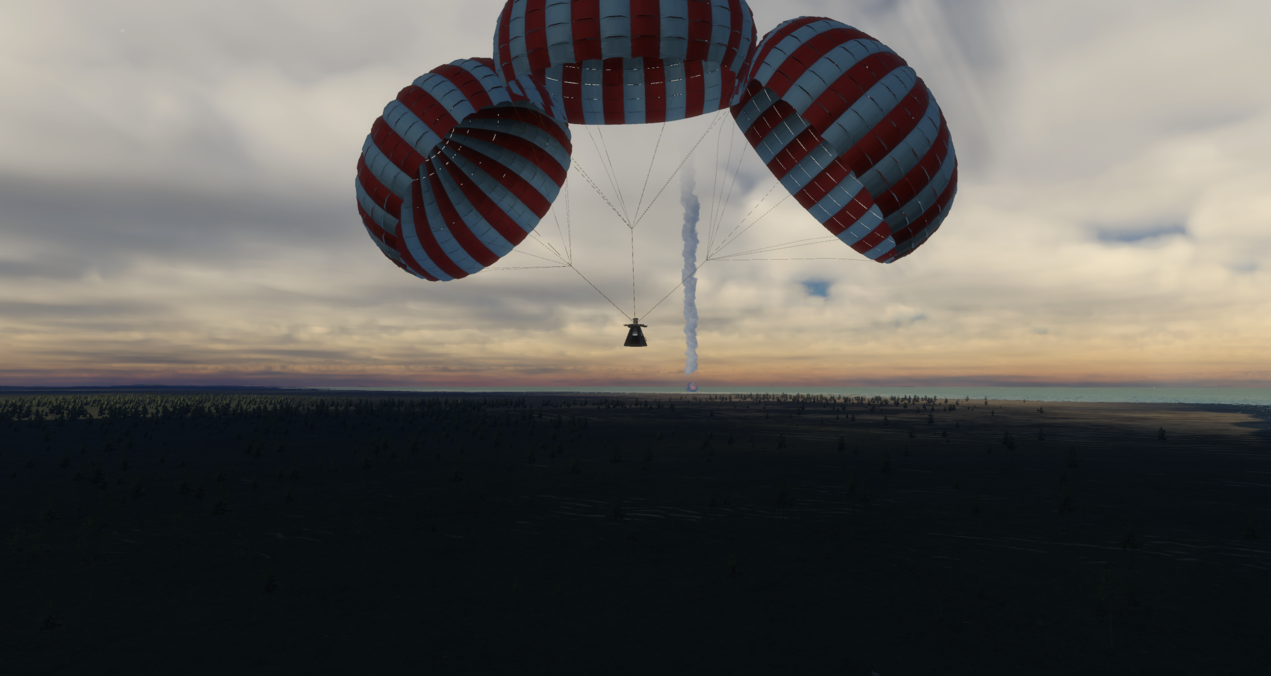
Parachutes, released in September, added another way to return a capsule. Their animated canopies accompany the descent, with a simpler visual treatment at high time warp. Launch escape hardware and separately sequenced module actions added further choices around crew safety and vehicle configuration.
We now have more of the systems needed to carry a flight from assembly and launch through rendezvous, docking, separation and an attempted return. The hardware chosen in the editor has a part to play throughout that journey.
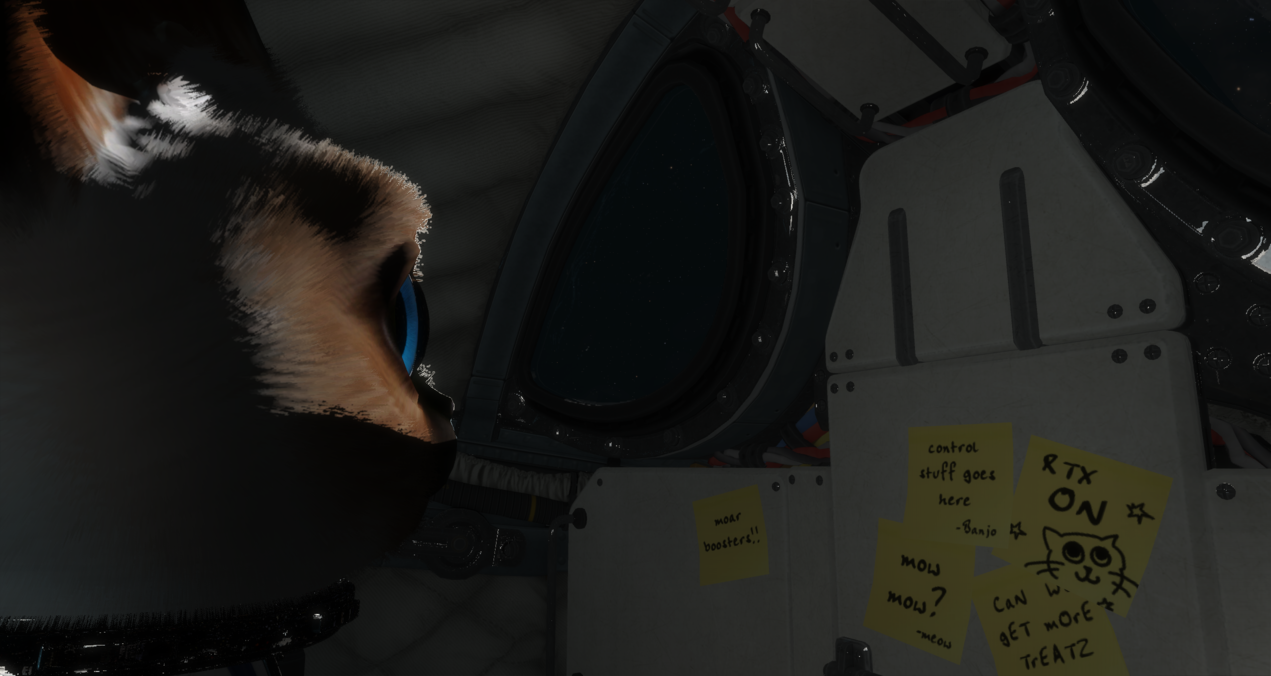
Early updates expanded the capsule's crew and developed its interior. Ray-traced interiors lighting brought more detail to the view from inside, alongside work on the seats, equipment and cabin itself. Entering and leaving the capsule connected those spaces with external activity.
August's roster and recovery systems gave individual kittens a record beyond a single flight. The roster brings together crew assignments, mission histories and the kittens available for another launch after returning to Earth. It tracks their time away and achievements across flights, and records those who do not make it home. Our crew and recovery update explains that system in more detail.
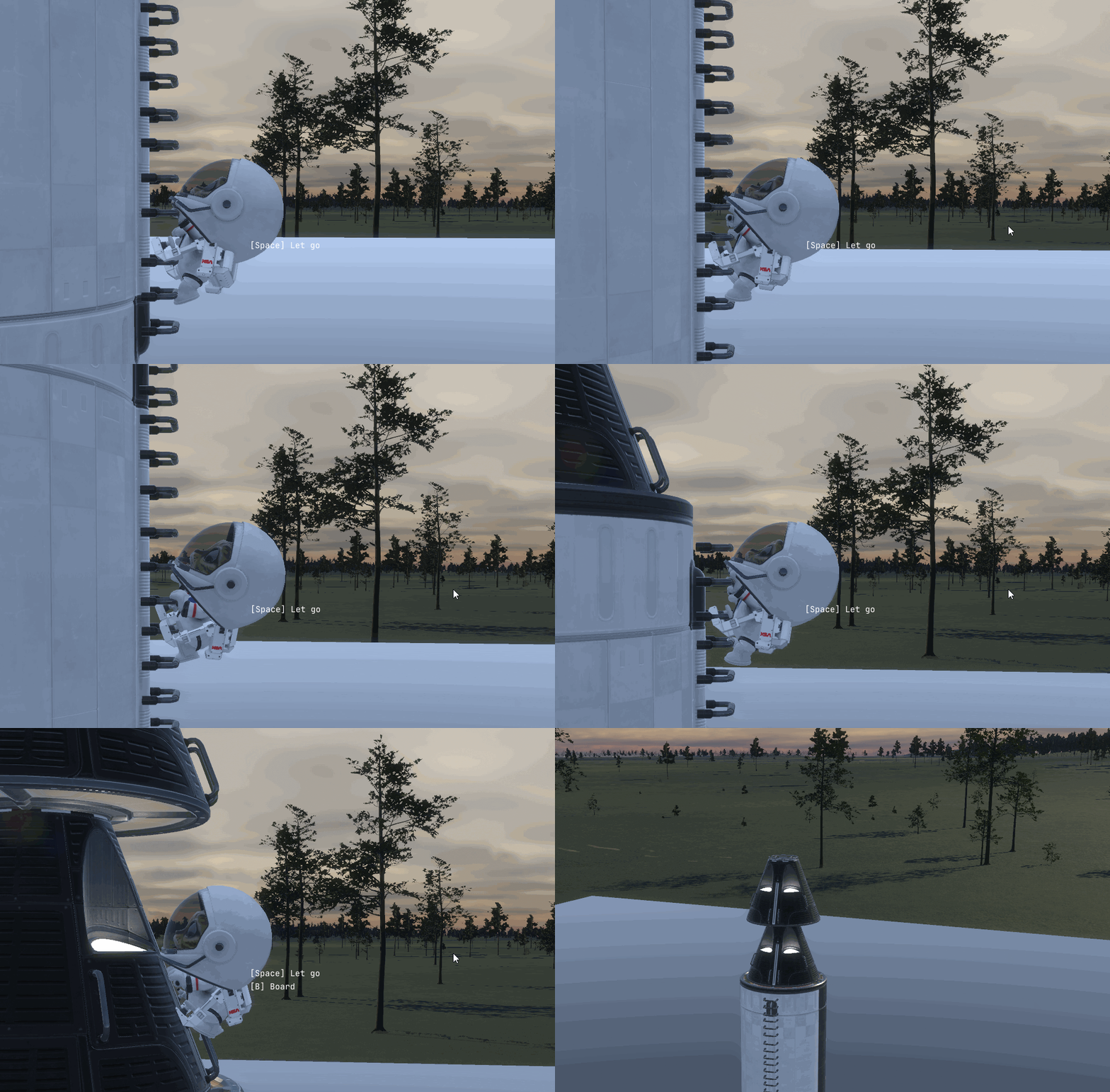
Walking, running, jumping, ladders and swimming have expanded what happens outside the capsule. A landing can lead to a trip across the surface on foot, while portrait cameras help keep track of the crew during flight.
November brought the first tier of life support. Crewed journeys now require oxygen, water, meals and carbon-dioxide scrubber canisters. Habitat zones determine which spaces share supplies, and opening a docking hatch can join those spaces together. Supply lockers extend the stores a vehicle can carry, while forecasts show how long they will last.
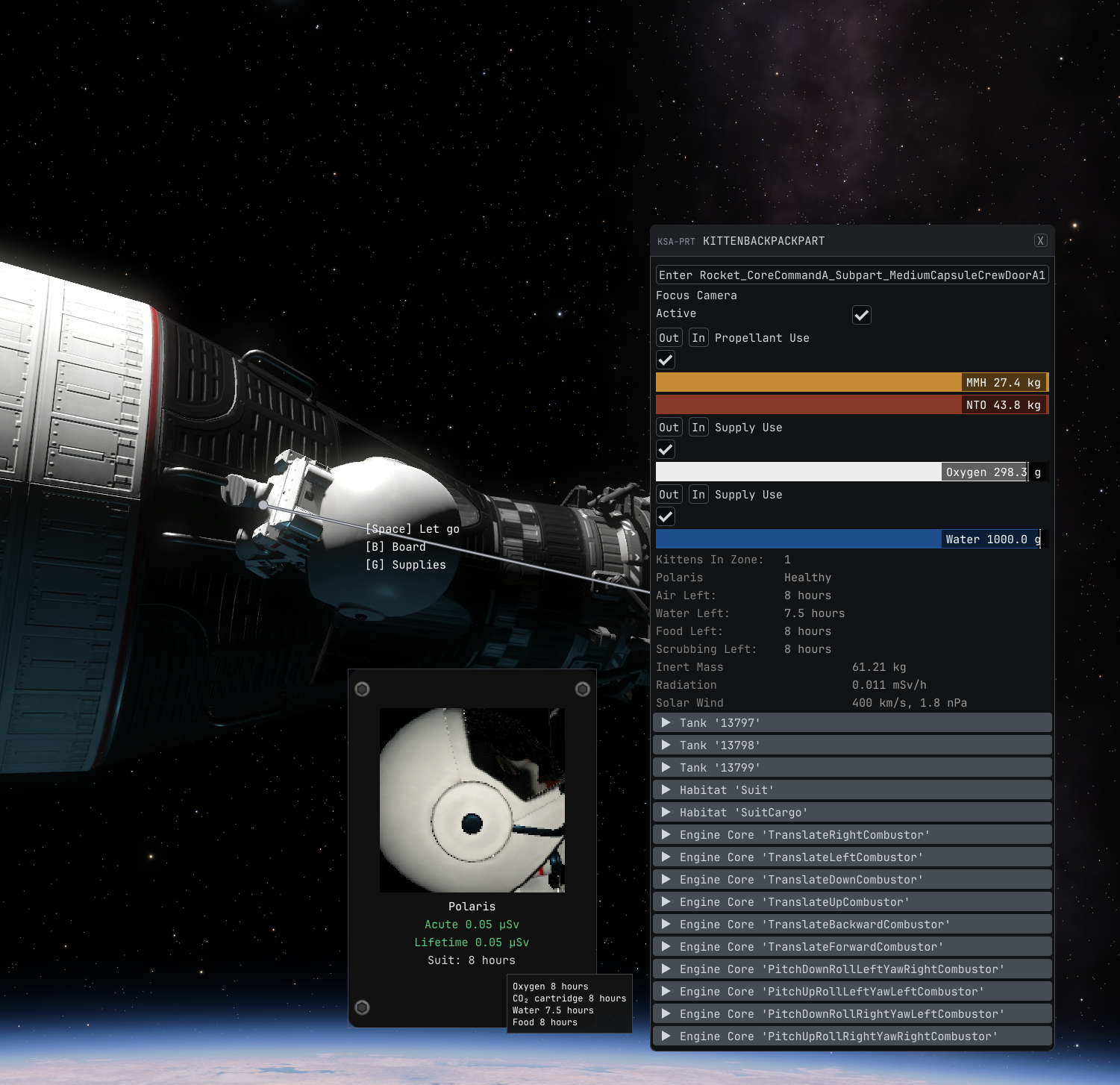
EVA suits have finite supplies too, and kittens can carry meals and canisters. Preparing for time outside becomes part of preparing the mission.
This first tier relies on supplies carried with the spacecraft. Supply recycling remains future work. For now, mission duration depends on the crew aboard and the stores packed before departure. The current build also includes per-save switches for life support and radiation while these systems continue to develop.
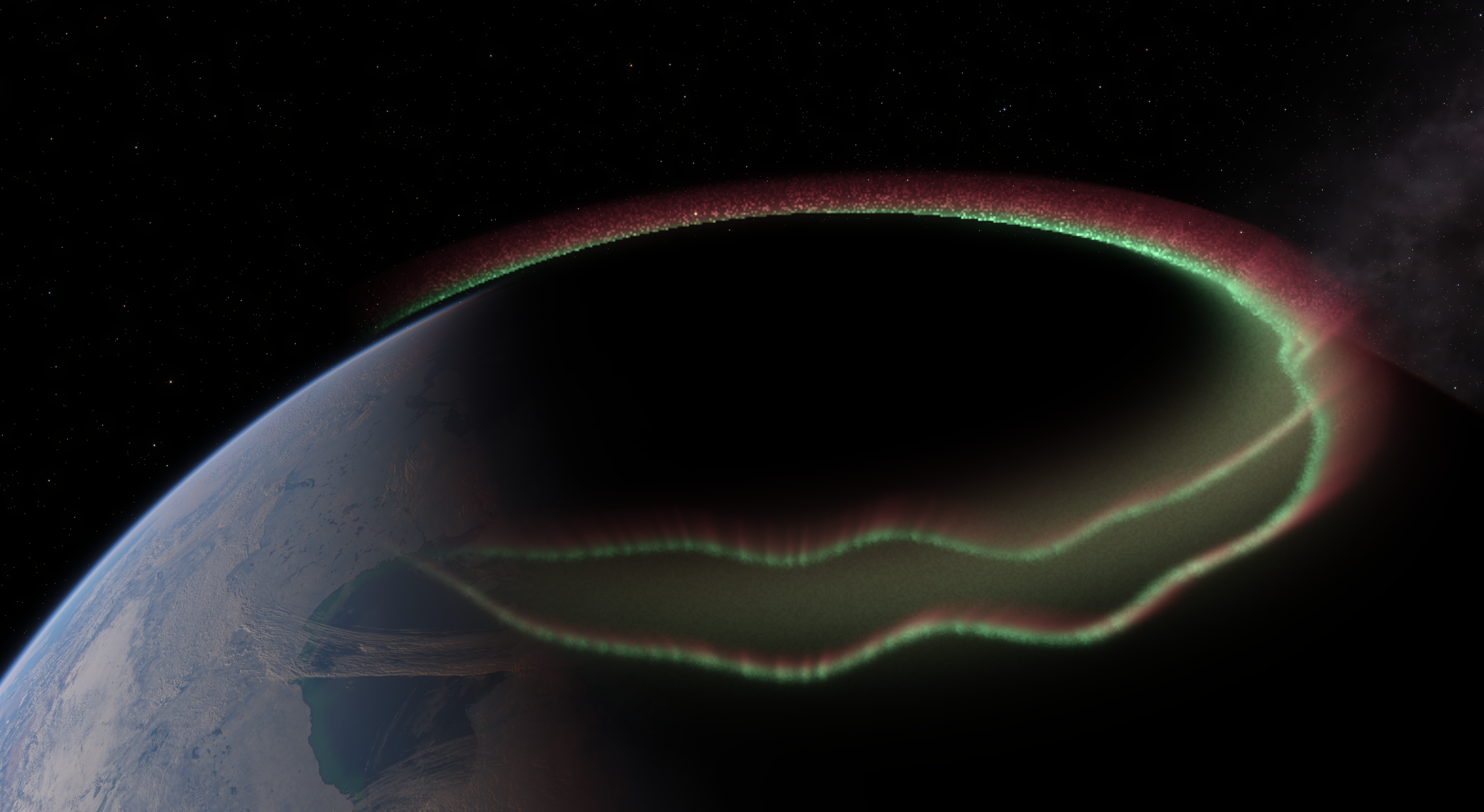
October introduced magnetic environments, radiation belts, aurorae and space-weather information. Further work connected exposure with crew health, shielding and stellar storms. A kitten's accumulated dose can affect their condition and eventually their ability to keep flying.
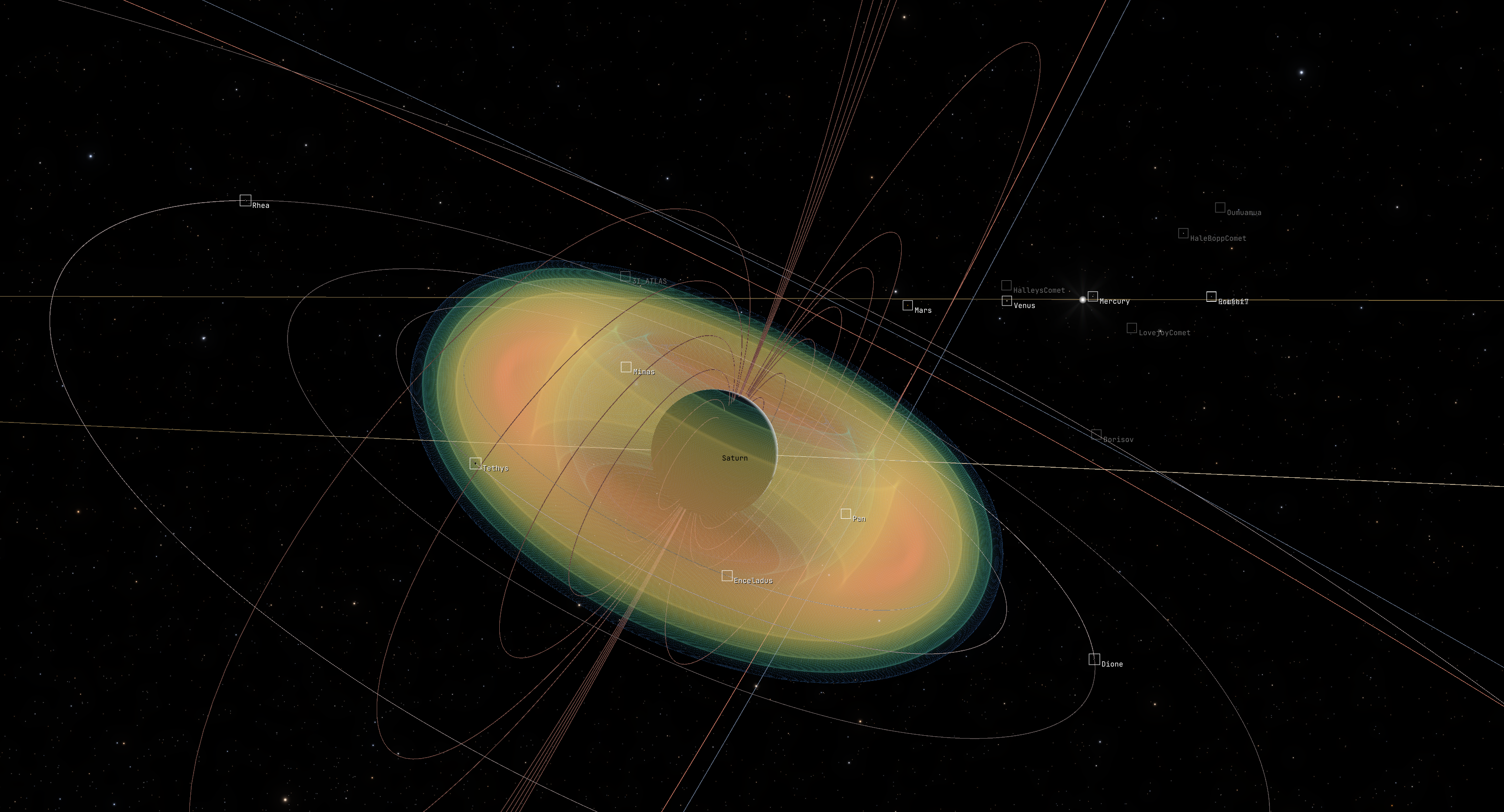
The accompanying forecasts, map information and dose readouts help make that risk visible. Planning a journey means considering where the crew will travel and how long they will remain exposed, as well as whether the spacecraft has enough propellant.
Our space-weather update explores the simulation in more depth. For the wider game, its significance is the connection between environments, vehicle design and the kittens inside. A beautiful view of an aurora belongs to the same world whose conditions the crew must live with.
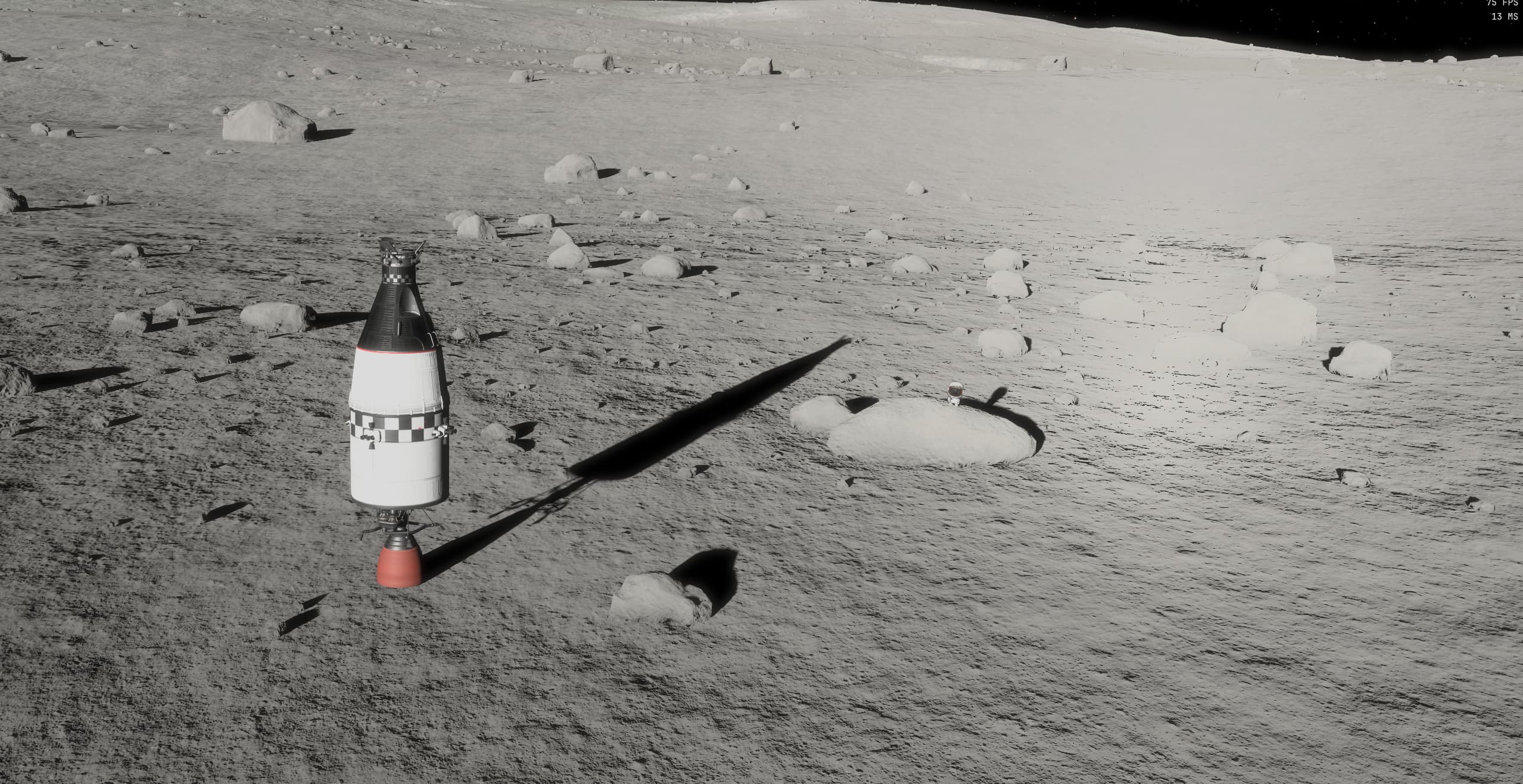
The Moon gained surface rocks, and later updates better matched their colour and orientation to the surrounding terrain. Grass and trees added detail around the launch site, where a new launchpad model blends more naturally into the ground. Once kittens could walk around, small shifts in the terrain that were easy to miss from a spacecraft became obvious beside a rock or landing leg. We’ve worked to keep the terrain stable as the camera moves from orbit to the ground. We’ve also begun experimenting with surface collisions, so rocks and trees can be knocked aside and stay where they come to rest.
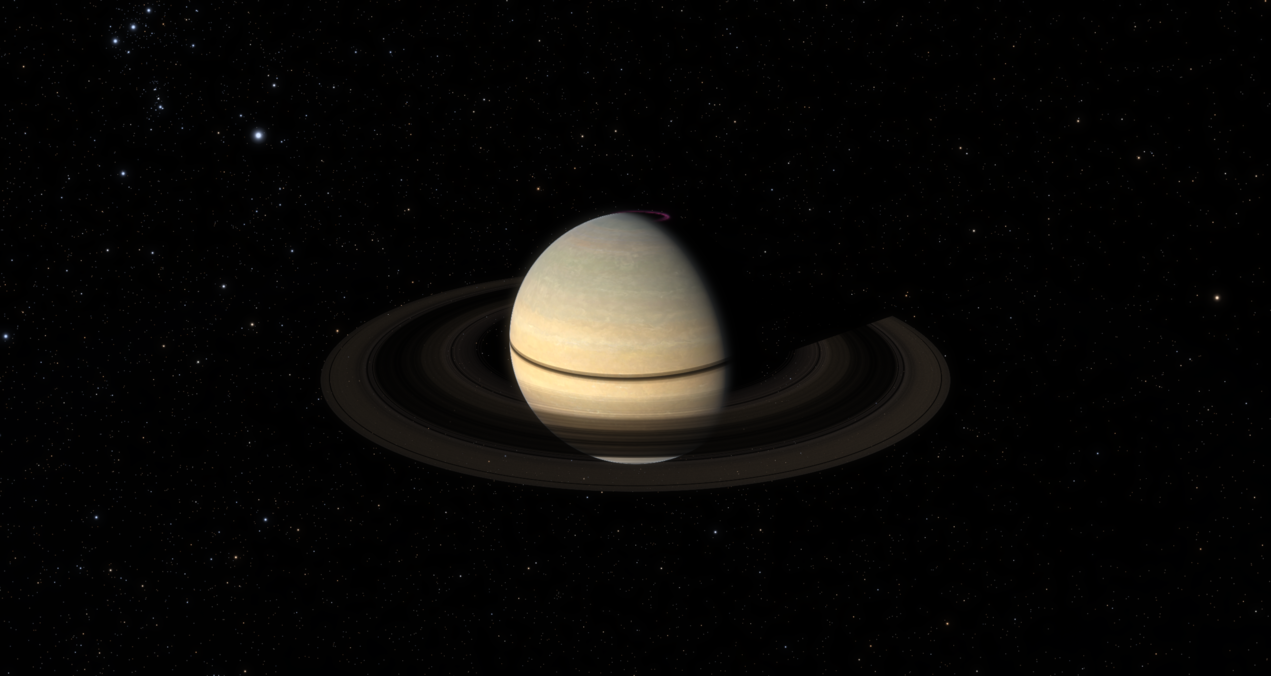
Planetary rings arrived in January, and we’ve since refined how they look as you approach. From a distance you see broad bands. Up close, you can pick out individual pieces, with material at different distances from the planet orbiting at different speeds. The planetary rings article goes into how those distant and close-up views fit together.
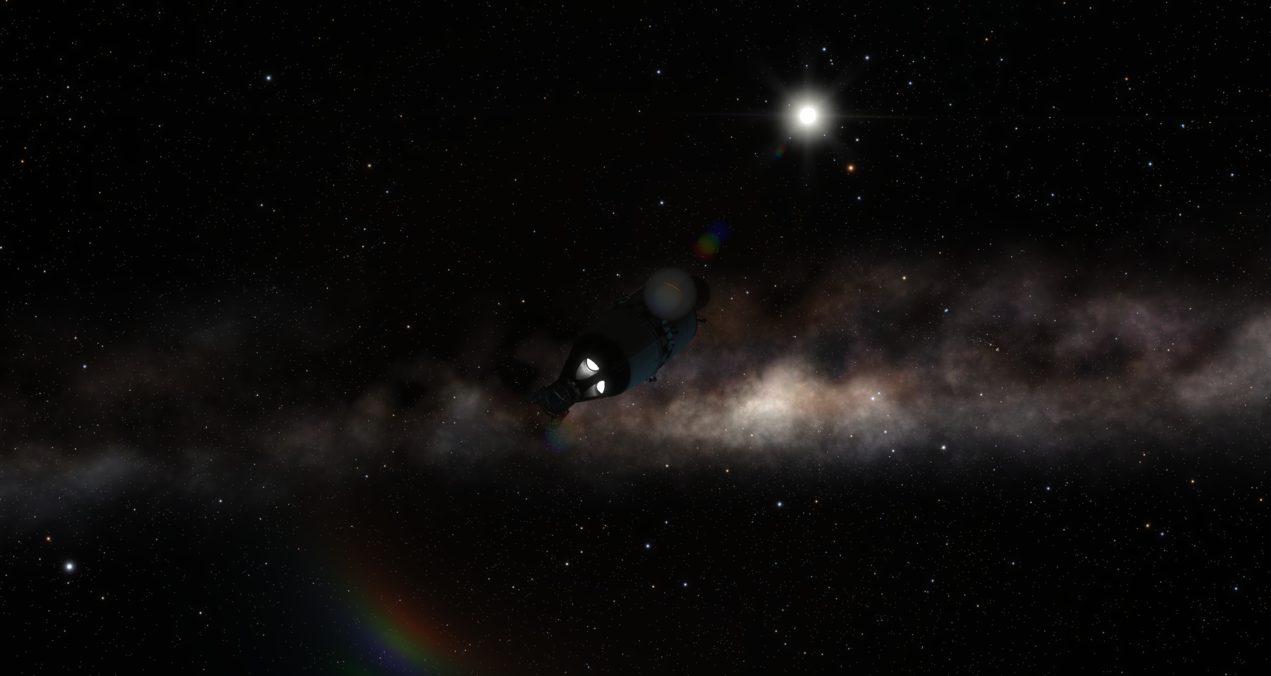
Beyond the planets, the Milky Way stretches across the sky, its bright centre crossed by dark dust lanes. You can catch it through the capsule window as a planet slips past, or look back at it from outside the spacecraft on an EVA.
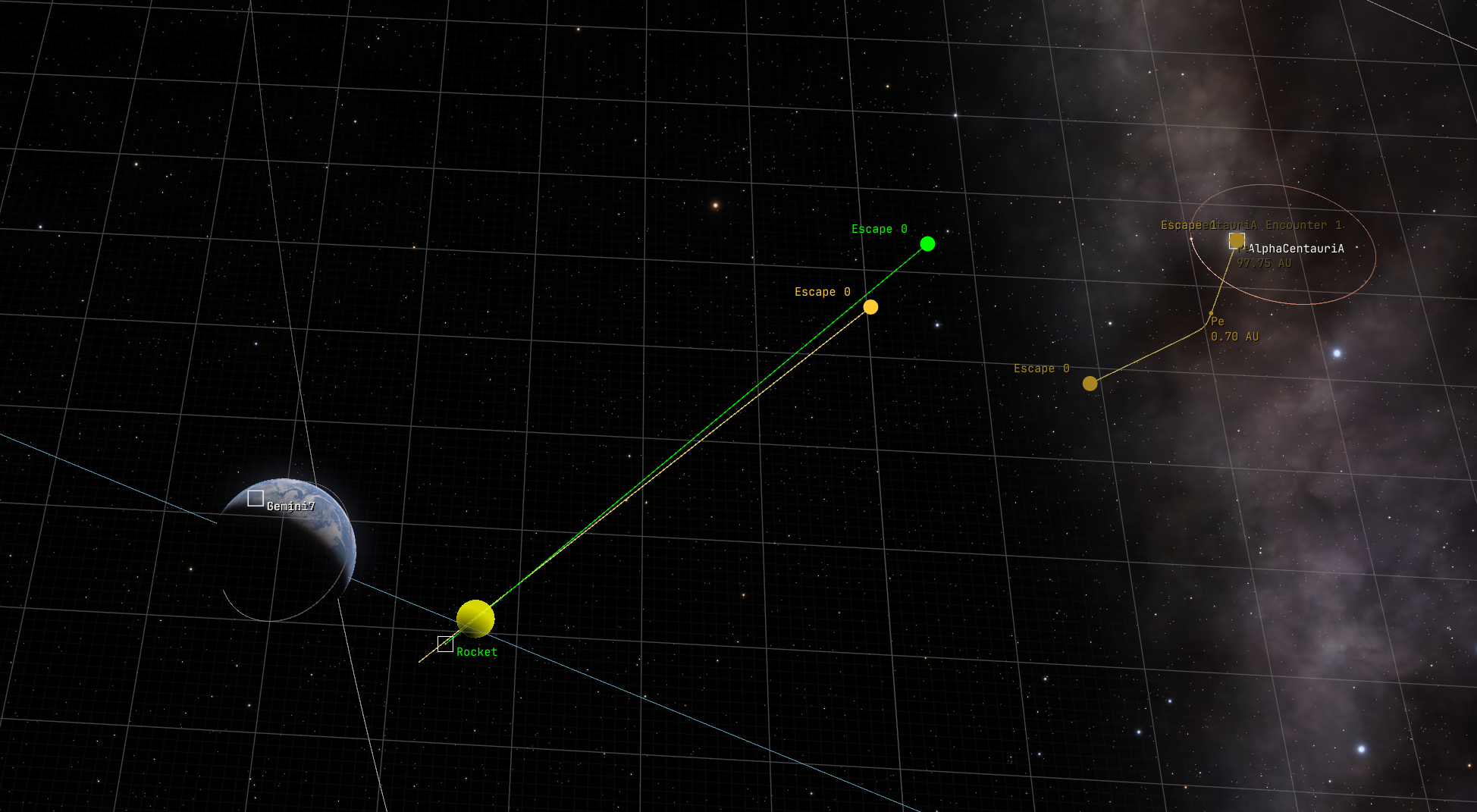
To make those flights work, the simulation has to handle the passage from one star system to another, predict trajectories during very long burns, and keep spacecraft orientation and control working at high time warp. We’ve added more nearby star systems, including binaries, and updated the star field.
We’re testing fusion and antimatter propulsion with placeholder parts. Their final role in the game is still open. The interstellar addendum article goes into the planning and propulsion work behind these first flights.
Spaceflight asks the simulation to handle a kitten beside a ladder, a vehicle approaching a docking port, a planet rotating beneath an orbit and a journey between stars. Keeping positions and motion accurate across those scales takes careful work on reference frames and numerical precision. BRUTAL, the C# framework we build KSA on, lets us use our own double-precision maths library to help keep those calculations accurate. We explained how the game tracks positions at different scales in our celestial coordinate frames article.
BRUTAL also gives us direct access to Vulkan, which lets us tune how KSA uses the graphics card. This year we improved how different views share rendering resources and reduced the cost of drawing terrain, surface clutter and rocket plumes. We also reorganised electrical circuits so connected parts no longer repeat the same calculations. Compiler optimisation, memory improvements and editor fixes helped keep the growing simulation practical to run.
We began testing native Linux builds in February and made them available alongside Windows builds on Ahwoo in May. In October, we opened beta testing for the Ahwoo client, which includes delta patching for KSA. When a new build is available, the client downloads only the data that has changed since the installed version, saving players from having to download the whole game again. Try the Ahwoo client beta.
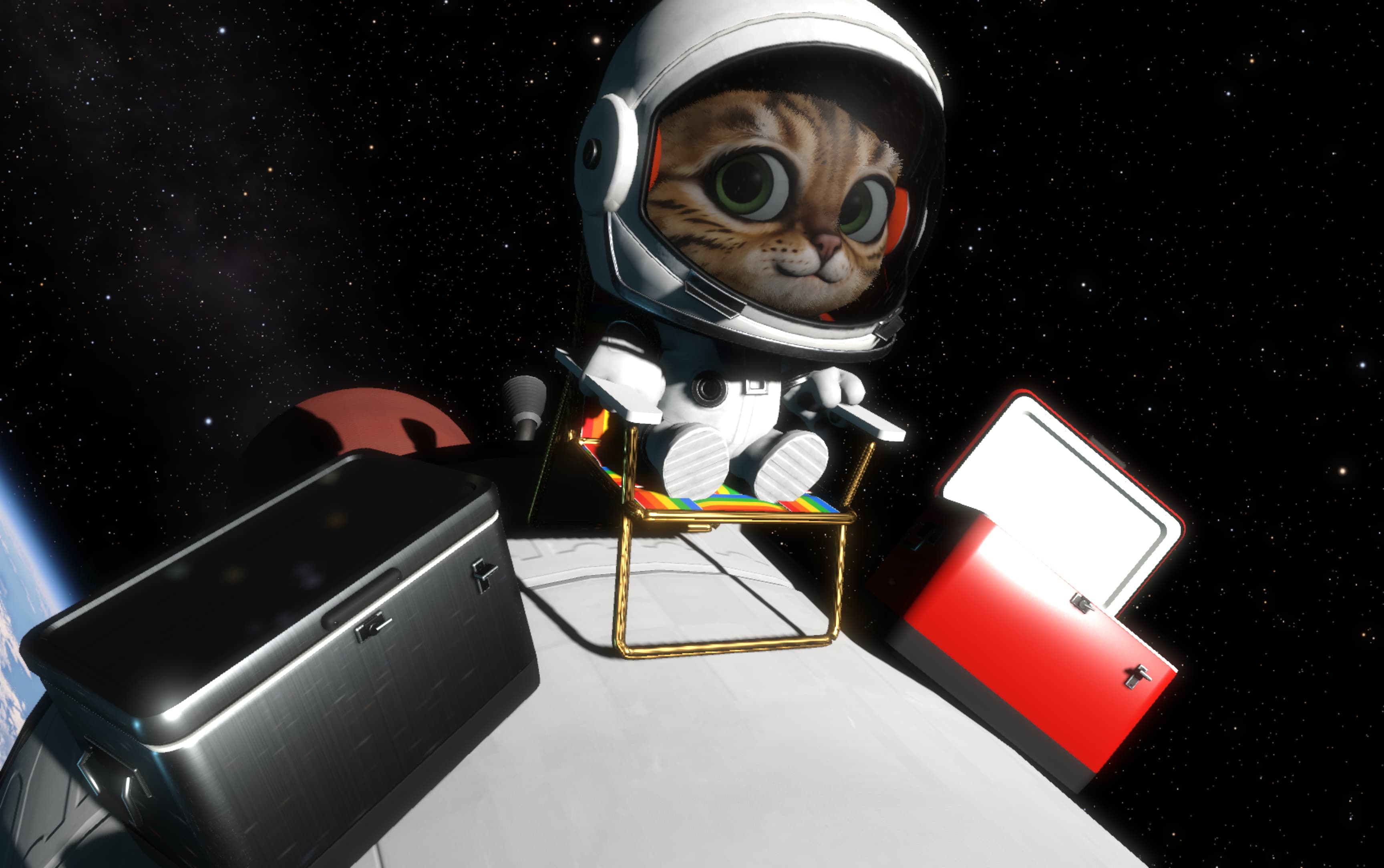
Screenshot from tomservo via KSA Discord.
Within 5 days of our public launch, we reported more than 50,000 downloads. From those early builds, people began testing what the simulation could do and making tools of their own.
Community mods appeared almost immediately. StarMap provided an early loader, while tools such as Kitten Engineer Redux and Lonely Planets explored telemetry and practical ways to run the developing simulation. Later projects included Powered Guidance for ascent and descent, gatOS connecting an operating-system to game data and controls, and kRPC for controlling KSA through scripts.
These are independently made community projects, with their own authors, updates and compatibility requirements. Modding a changing pre-alpha takes work, and we appreciate the people who have kept adapting their projects as the game changes.
Our own data and modding tools have developed alongside them. November's XML changes added more structured ways to reference and modify game data..
Players and creators have helped document KSA throughout the year. Goddchen's regular summaries have followed new builds and demonstrations, while ShadowZone has shared mission builds and explored new features. Kiwi Shark has also helped showcase the community's work and has been a bedrock within the KSA Discord & KSA Community Wiki. We are grateful for the time and care they put into covering a game that is still changing, and for sharing it with their audiences.
The feedback has been just as valuable. Reports about craft that failed to save, unexpected parachute behaviour or life-support information that was hard to find give us a clearer picture of what it is like to play each build. Thank you for taking the time to write those reports and help us work through them.
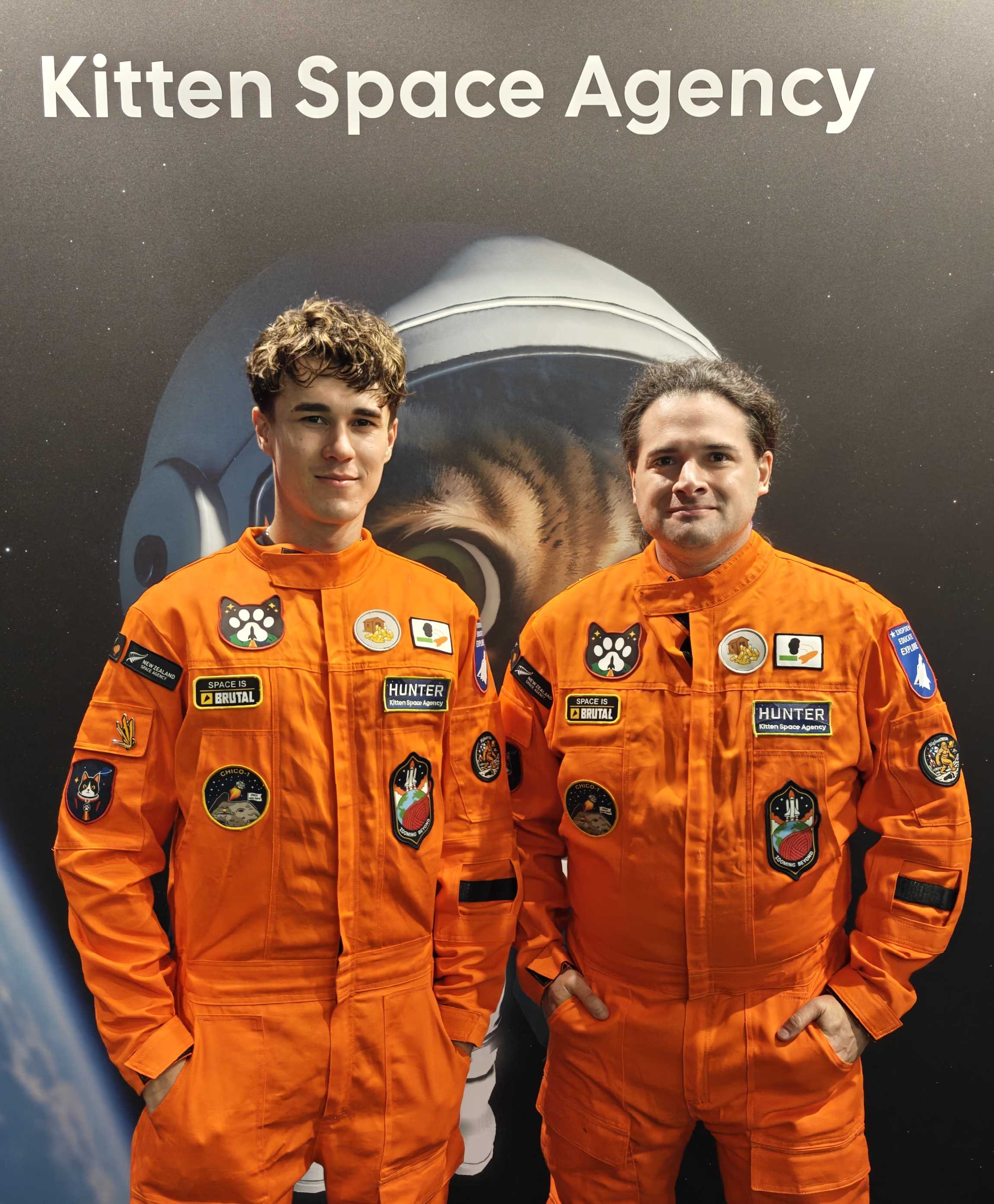
Taylor Taylor, Product Marketing Manager at Ahwoo, and Felipe Falanghe, Creator of Kerbal Space Program.
In August, we took KSA to Gamescom in Germany. We spend much of the year talking with the community on Discord and the forums, so it was good to show the game and meet people in person. Thank you to everyone who stopped by our booth.
Life support has further tiers ahead. Physics, aerodynamics, environments and the tools used to build and fly vehicles will continue to develop. Some of the most useful work will be in making existing systems easier to understand and more dependable when used together.
KSA remains in pre-alpha, and we will keep sharing the progress, experiments and unfinished parts along the way.
Thank you to everyone who has spent part of this year with Kitten Space Agency. To our players, testers, modders, creators and contributors: thank you for helping us get here.
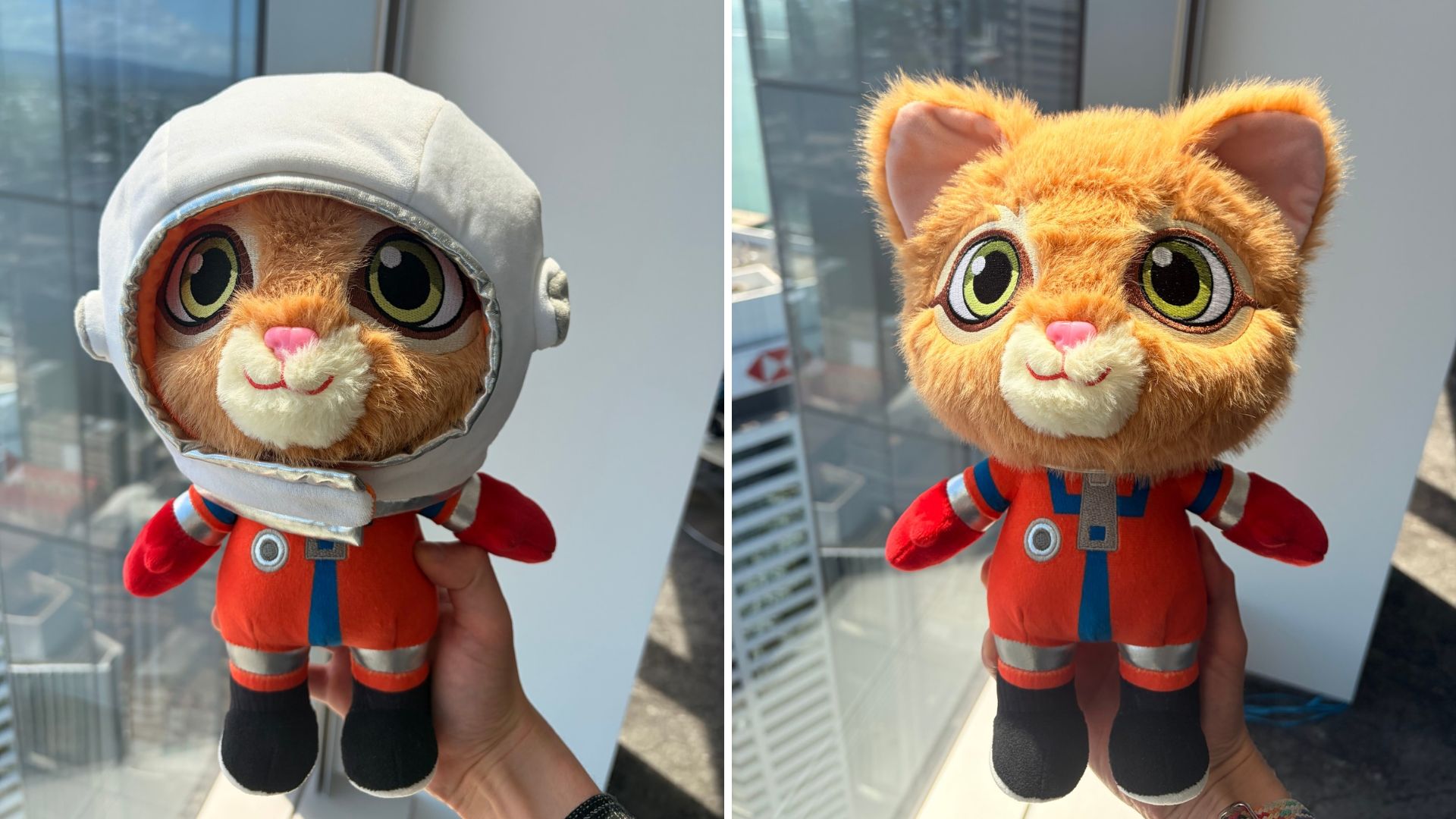
Before we go, one small tease: we have also been working on a Kitten Space Agency plushie. We will have more to share when it is ready.
We began developing KSA in mid-2024 and opened the pre-alpha to everyone on 14 November 2025. Since that public launch, we have released more than 115 public versions, from small fixes to updates that have introduced entirely new systems.
Kitten Space Agency is still pre-alpha as we continue to add systems, revisit early work and fix the problems that come from putting it all together. For this anniversary, we want to share what that first year of public development has made possible.
Keeping KSA free, together
RocketWerkz is committed to keeping Kitten Space Agency free to download and play. Our core belief remains unchanged:We want anyone who’s curious about space to be able to play, regardless of what they can afford.the first people to set foot on Mars will trace their journey back to this game.
Thank you to our patrons Murasaki, Noé, Rigel Alula, Cesar, Rigel_Proto, Pimiento, tomservo and BigfootMSR, and to everyone who’s contributed to Kitten Space Agency over the past year. Your support helps us keep building a game that everyone can play for free. We’re grateful to have you with us this early in development.
By our rough estimate, more than 130,000 development hours have gone into KSA so far. Community contributions have covered around 2% of the game's real-world development costs, with RocketWerkz funding the rest. Those contributions remain optional, and every contribution helps support the work.
Whether you have contributed, tested a build, reported a problem, made a mod or simply taken a kitten somewhere interesting, thank you for being part of this first year.
Four years of groundwork
Four years ago, we started building BRUTAL. What began as a few libraries and grew into the C# framework we use to build Kitten Space Agency. The source code is now public, and BRUTAL is used in five other games, including Ludeon Studios’ RimWorld, where it powers the Waylith engine.One of our first experiments with it was a small orbital mechanics demo. Some of that work ended up powering the sky in Stationeers before we began developing KSA.
Much of the work before the public pre-alpha went into getting the simulation and graphics to run independently. BRUTAL gave us the tools to build both around the needs of a space sim. We could use our own maths library to keep orbital paths stable across the Solar System and build a renderer that could handle entire planets as well as individual spacecraft parts. We’re starting to see those years of work pay off in the game itself.
We’re also celebrating Ahwoo’s first anniversary. Getting a KSA build ready was only part of going public. We needed a way to get it into people’s hands for free and let anyone who wanted to help contribute towards development. Ahwoo gave us both, along with dedicated KSA forums where players can report bugs, ask questions, share mods and show us what they’ve built. That gave us a place to hear directly from players as we worked on the next build.
Special thanks to the BRUTAL and Ahwoo teams whose work make Kitten Space Agency possible.
From prebuilt spacecraft to your own designs
One of the biggest changes this year has been going from flying the spacecraft we supplied to building your own. What began as a rough debug tool became a dedicated Vehicle Editor in June, with a part browser and a workspace for assembling and saving designs. Automatic staging helps you plan when engines fire and spent hardware separates, while delta-v and thrust-to-weight estimates help you check whether a rocket can lift off and has enough propellant for the journey. New parts such as engine plates, solid rocket boosters and modular service bays give you more ways to build, and November’s undo and redo tools make it easier to try out a design.
We’ve also built out the systems that make those spacecraft work. Engines now respond to changes in atmospheric pressure, and gimbals let you steer with thrust. Propellant follows the connections between parts, so a pair of boosters can feed a central stage through fuel lines that are severed when the boosters separate. A flow overlay shows which tanks each engine can draw from. Batteries, generators and deployable solar panels that track the Sun give you ways to keep equipment powered in flight.
Planning a flight
Before launch, the next question is where the spacecraft is going and how it will get there.Orbital trajectories and flight planning were already part of the first public build. This year, we have worked on making those paths more useful as spacecraft and their journeys become more complicated.
Adjusting a planned burn changes the predicted path, while closest-approach information helps with working towards an encounter. April's target-tracking window made relative position and velocity easier to understand. Burn editing brought more of that planning into the same window.
Later prediction work accounts for the duration of a burn and changes between stages. A spacecraft keeps moving while its engines fire, so the trajectory needs to reflect the whole manoeuvre and the changing vehicle as stages separate.
Ground tracks have also gained support for planned burns, showing where a route passes over the surface below. Together, these tools make it easier to compare a plan with the flight it is meant to produce.
Rocket plumes from liftoff to orbit
A launch is one of the clearest places to see the year's visual changes. We have spent much of it developing how plumes form at the engine, expand into the surrounding air and leave a trail behind a moving vehicle.April brought physically driven plume rendering, using gas properties to inform shape and density. Shock cells and Mach diamonds followed, then heat refraction in May. Volumetric trails arrived experimentally in July, with solid rocket boosters providing an early application.
Later updates developed how exhaust responds to movement and airflow, how nearby plumes combine, and how exhaust, clouds and explosions overlap. October added shadows from the trails across the scene. Cloud-shadow work also improved how low-angle light falls across the landscape
Plumes from several engines can combine as a rocket climbs. Exhaust can overlap with clouds, and trails can cast shadows across the scene. Getting those effects to work together has meant connecting the propulsion simulation with the renderer.
There are still approximations and refinements to work through, however, progress is visible in the changing shape of the exhaust and the trail stretching back towards the launchpad.
Meeting in orbit and making contact
Bringing two spacecraft close together leaves the final task of lining them up and making contact. Docking cameras and port targeting help with that approach.Docking itself passed through several stages. March's early implementation joined nearby vehicles through a proximity-based workflow. In June, docking moved to physical contact between ports, followed by further work on how a latch responds to the encounter.
That change depended on a broader improvement to collisions. Nearby vehicles initially interacted through coarse bounding shapes. Fine part colliders then brought contact closer to the actual spacecraft geometry, making the shapes of individual components matter when two craft meet.
The same work affects landing and failure. We addressed contact stability and settling, added whole-vehicle destruction, and then moved to individual part destruction in September. A collision can break a craft into separate pieces. Deformation, explosions and sound give those events a visible and audible result.
Parachutes, released in September, added another way to return a capsule. Their animated canopies accompany the descent, with a simpler visual treatment at high time warp. Launch escape hardware and separately sequenced module actions added further choices around crew safety and vehicle configuration.
We now have more of the systems needed to carry a flight from assembly and launch through rendezvous, docking, separation and an attempted return. The hardware chosen in the editor has a part to play throughout that journey.
Bringing the kittens home
The kittens now have a history that can continue from one flight to the next.Early updates expanded the capsule's crew and developed its interior. Ray-traced interiors lighting brought more detail to the view from inside, alongside work on the seats, equipment and cabin itself. Entering and leaving the capsule connected those spaces with external activity.
August's roster and recovery systems gave individual kittens a record beyond a single flight. The roster brings together crew assignments, mission histories and the kittens available for another launch after returning to Earth. It tracks their time away and achievements across flights, and records those who do not make it home. Our crew and recovery update explains that system in more detail.
Walking, running, jumping, ladders and swimming have expanded what happens outside the capsule. A landing can lead to a trip across the surface on foot, while portrait cameras help keep track of the crew during flight.
November brought the first tier of life support. Crewed journeys now require oxygen, water, meals and carbon-dioxide scrubber canisters. Habitat zones determine which spaces share supplies, and opening a docking hatch can join those spaces together. Supply lockers extend the stores a vehicle can carry, while forecasts show how long they will last.
EVA suits have finite supplies too, and kittens can carry meals and canisters. Preparing for time outside becomes part of preparing the mission.
This first tier relies on supplies carried with the spacecraft. Supply recycling remains future work. For now, mission duration depends on the crew aboard and the stores packed before departure. The current build also includes per-save switches for life support and radiation while these systems continue to develop.
Planning around space weather
Time away from home also matters because space has its own environmental hazards.October introduced magnetic environments, radiation belts, aurorae and space-weather information. Further work connected exposure with crew health, shielding and stellar storms. A kitten's accumulated dose can affect their condition and eventually their ability to keep flying.
The accompanying forecasts, map information and dose readouts help make that risk visible. Planning a journey means considering where the crew will travel and how long they will remain exposed, as well as whether the spacecraft has enough propellant.
Our space-weather update explores the simulation in more depth. For the wider game, its significance is the connection between environments, vehicle design and the kittens inside. A beautiful view of an aurora belongs to the same world whose conditions the crew must live with.
Worlds worth exploring
Some changes are easiest to appreciate during a quiet moment in flight. We’ve worked on the view from inside the capsule, the ground beneath a lander and the sky beyond the planets. Later updates refined terrain materials, ice and the way the Moon reflects light.The Moon gained surface rocks, and later updates better matched their colour and orientation to the surrounding terrain. Grass and trees added detail around the launch site, where a new launchpad model blends more naturally into the ground. Once kittens could walk around, small shifts in the terrain that were easy to miss from a spacecraft became obvious beside a rock or landing leg. We’ve worked to keep the terrain stable as the camera moves from orbit to the ground. We’ve also begun experimenting with surface collisions, so rocks and trees can be knocked aside and stay where they come to rest.
Planetary rings arrived in January, and we’ve since refined how they look as you approach. From a distance you see broad bands. Up close, you can pick out individual pieces, with material at different distances from the planet orbiting at different speeds. The planetary rings article goes into how those distant and close-up views fit together.
Beyond the planets, the Milky Way stretches across the sky, its bright centre crossed by dark dust lanes. You can catch it through the capsule window as a planet slips past, or look back at it from outside the spacecraft on an EVA.
Beyond the Solar System
October’s interstellar update made it possible to fly a spacecraft beyond the Solar System. An interstellar flight starts with a burn to build up speed, followed by a long coast and a second burn to slow down at the destination. The Transfer Planner accounts for both burns, the flight computer carries them out, and expanded time warp lets us test the long coast between them.To make those flights work, the simulation has to handle the passage from one star system to another, predict trajectories during very long burns, and keep spacecraft orientation and control working at high time warp. We’ve added more nearby star systems, including binaries, and updated the star field.
We’re testing fusion and antimatter propulsion with placeholder parts. Their final role in the game is still open. The interstellar addendum article goes into the planning and propulsion work behind these first flights.
The work underneath
Many of the year’s important changes are easiest to notice when something stops going wrong.Spaceflight asks the simulation to handle a kitten beside a ladder, a vehicle approaching a docking port, a planet rotating beneath an orbit and a journey between stars. Keeping positions and motion accurate across those scales takes careful work on reference frames and numerical precision. BRUTAL, the C# framework we build KSA on, lets us use our own double-precision maths library to help keep those calculations accurate. We explained how the game tracks positions at different scales in our celestial coordinate frames article.
BRUTAL also gives us direct access to Vulkan, which lets us tune how KSA uses the graphics card. This year we improved how different views share rendering resources and reduced the cost of drawing terrain, surface clutter and rocket plumes. We also reorganised electrical circuits so connected parts no longer repeat the same calculations. Compiler optimisation, memory improvements and editor fixes helped keep the growing simulation practical to run.
We began testing native Linux builds in February and made them available alongside Windows builds on Ahwoo in May. In October, we opened beta testing for the Ahwoo client, which includes delta patching for KSA. When a new build is available, the client downloads only the data that has changed since the installed version, saving players from having to download the whole game again. Try the Ahwoo client beta.
Screenshot from tomservo via KSA Discord.
Building with the community
Throughout the year, the community has found new uses for KSA, often while we were still working out the tools ourselves.Within 5 days of our public launch, we reported more than 50,000 downloads. From those early builds, people began testing what the simulation could do and making tools of their own.
Community mods appeared almost immediately. StarMap provided an early loader, while tools such as Kitten Engineer Redux and Lonely Planets explored telemetry and practical ways to run the developing simulation. Later projects included Powered Guidance for ascent and descent, gatOS connecting an operating-system to game data and controls, and kRPC for controlling KSA through scripts.
These are independently made community projects, with their own authors, updates and compatibility requirements. Modding a changing pre-alpha takes work, and we appreciate the people who have kept adapting their projects as the game changes.
Our own data and modding tools have developed alongside them. November's XML changes added more structured ways to reference and modify game data..
Players and creators have helped document KSA throughout the year. Goddchen's regular summaries have followed new builds and demonstrations, while ShadowZone has shared mission builds and explored new features. Kiwi Shark has also helped showcase the community's work and has been a bedrock within the KSA Discord & KSA Community Wiki. We are grateful for the time and care they put into covering a game that is still changing, and for sharing it with their audiences.
The feedback has been just as valuable. Reports about craft that failed to save, unexpected parachute behaviour or life-support information that was hard to find give us a clearer picture of what it is like to play each build. Thank you for taking the time to write those reports and help us work through them.
From the NZ Hi-Tech Awards to Gamescom
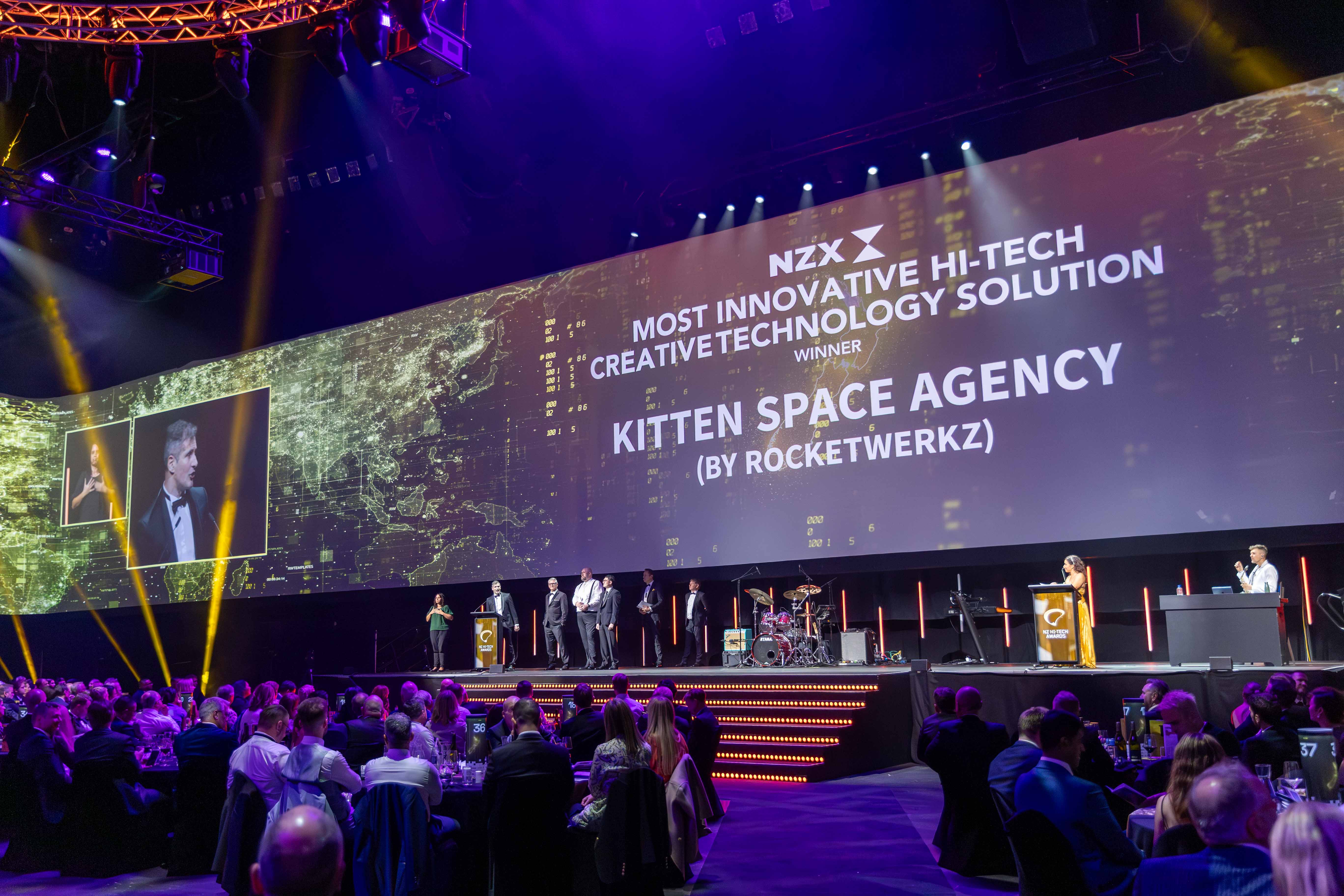
In May, Kitten Space Agency won the NZX Most Innovative Hi-Tech Creative Technology Solution award at the 2026 NZ Hi-Tech Awards. It was a proud moment for the team to see the technical work behind the game recognised.
Taylor Taylor, Product Marketing Manager at Ahwoo, and Felipe Falanghe, Creator of Kerbal Space Program.
In August, we took KSA to Gamescom in Germany. We spend much of the year talking with the community on Discord and the forums, so it was good to show the game and meet people in person. Thank you to everyone who stopped by our booth.
Looking ahead
A year into public development, we have more of the systems needed to build a spacecraft, plan a journey, manage its resources and bring its crew home. We can also see more clearly where those systems need further work.Life support has further tiers ahead. Physics, aerodynamics, environments and the tools used to build and fly vehicles will continue to develop. Some of the most useful work will be in making existing systems easier to understand and more dependable when used together.
KSA remains in pre-alpha, and we will keep sharing the progress, experiments and unfinished parts along the way.
Thank you to everyone who has spent part of this year with Kitten Space Agency. To our players, testers, modders, creators and contributors: thank you for helping us get here.
Before we go, one small tease: we have also been working on a Kitten Space Agency plushie. We will have more to share when it is ready.
Enjoyed this update?
Support the team behind Kitten Space Agency to keep updates like this coming.


