
Beyond the Sun
Up to now, every star in KSA's sky has been a dot on the skybox. Pretty, but totally out of reach. That changes now with two new starting systems: Solar System + Interstellar and Earth Only + Interstellar.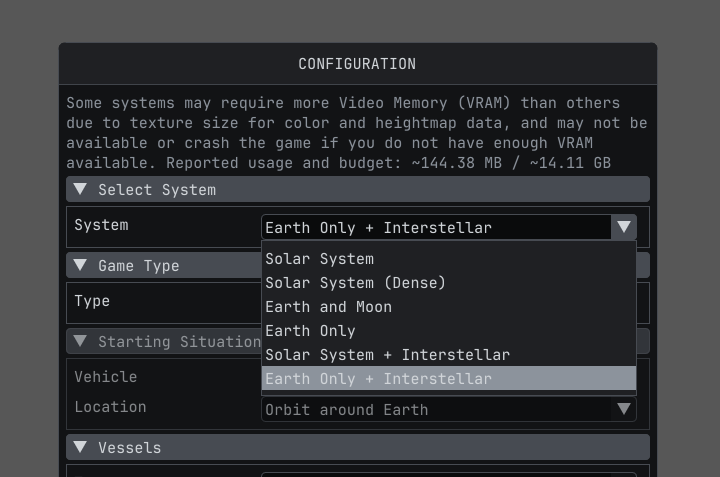
Star Distance What's there
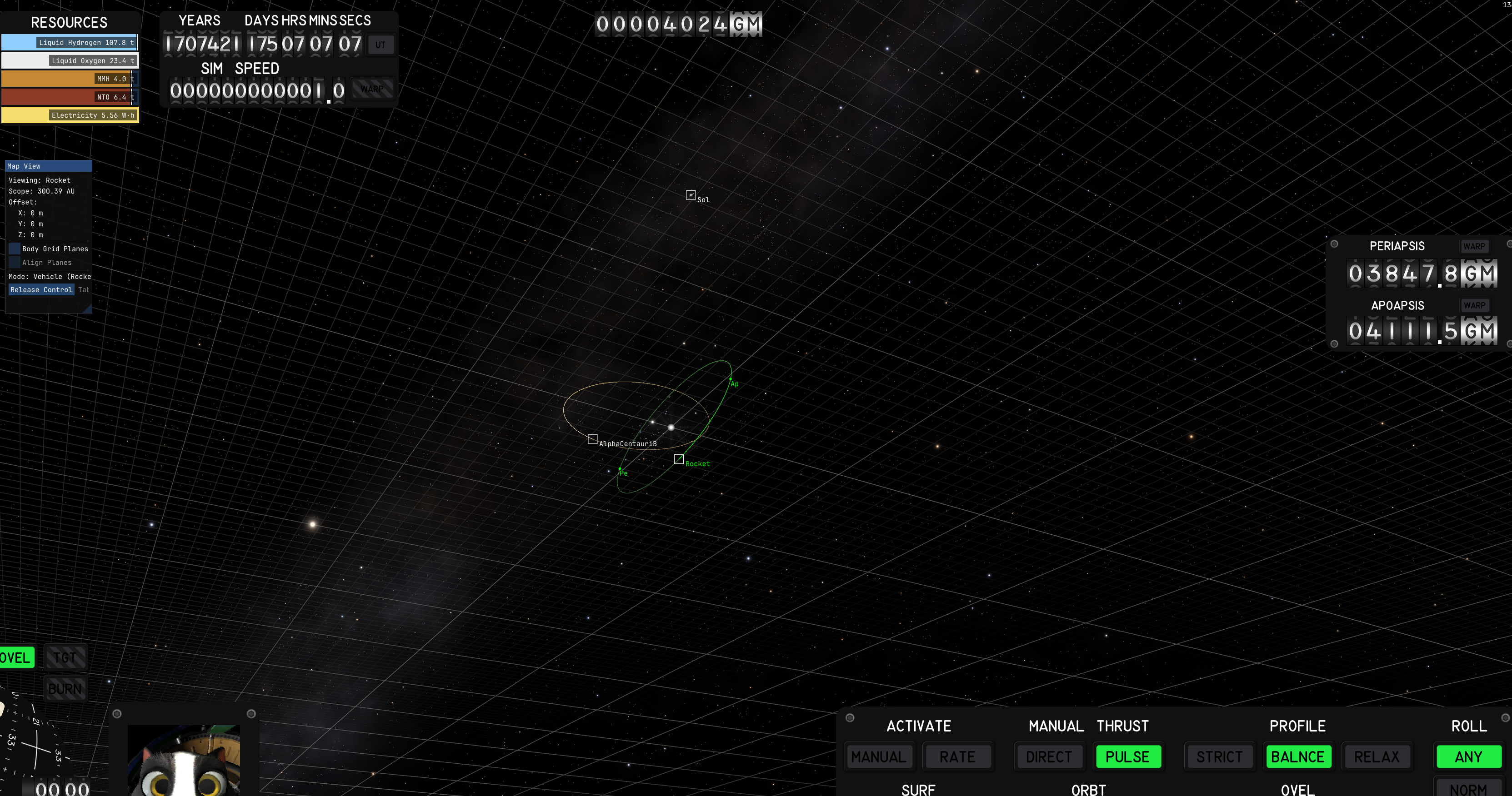
Alpha Centauri A 4.344 ly Alpha Centauri B, Proxima Centauri, and Proxima b and d
Barnard's Star 5.963 ly Barnard's Star b, c, d and e
Tau Ceti 11.912 ly Tau Ceti f, g and h
I only included planets that have held up as real detections. Retracted or marginal claims like Alpha Centauri Bb and Proxima c, were left out.
Real distances and real directions
In order to fully test and prove out the Brutal engine and KSA's architecture we have not squashed the gap between stars... yet....Alpha Centauri sits 4.344 light years out taken from its measured parallax and in the same direction as its dot on the skybox. Fly towards the star you can see and you'll get there.
Introducing Light years into the equations do break some things that were fine inside one solar system.
A double-precision number 1 light year from the origin can only step in about 2 m increments. Anything placed as "absolute position plus a small offset" starts rounding off. I found this in the crew portrait cameras which crashed near 1 light year. I also saw it in the map camera, which juddered around a ship 2 light years out. Both the crew portrait camera and the map camera are now placed relative to what they are following which is exact at any distance.
A few other things that didn't work but now work with more than one star:
- Lighting follows the nearest star to your camera. Travel to Alpha Centauri and it becomes your sun: lighting, flare and bloom all switch over.
- Solar panels track their own star. The one nearest the vessel not whichever one the camera is looking at.
- Other stars render as bright points you can pick out, with a marker, rather than vanishing when they aren't the current sun.
- The Ground Track and Target Tracking windows know which star you're at. Both used to assume the sun sits at the centre of the universe. At another star the ground track's day/night shading and the rendezvous plot's sun direction would have pointed back at Sol. They now use the star nearest the body you're orbiting.
Who owns the space between the stars?
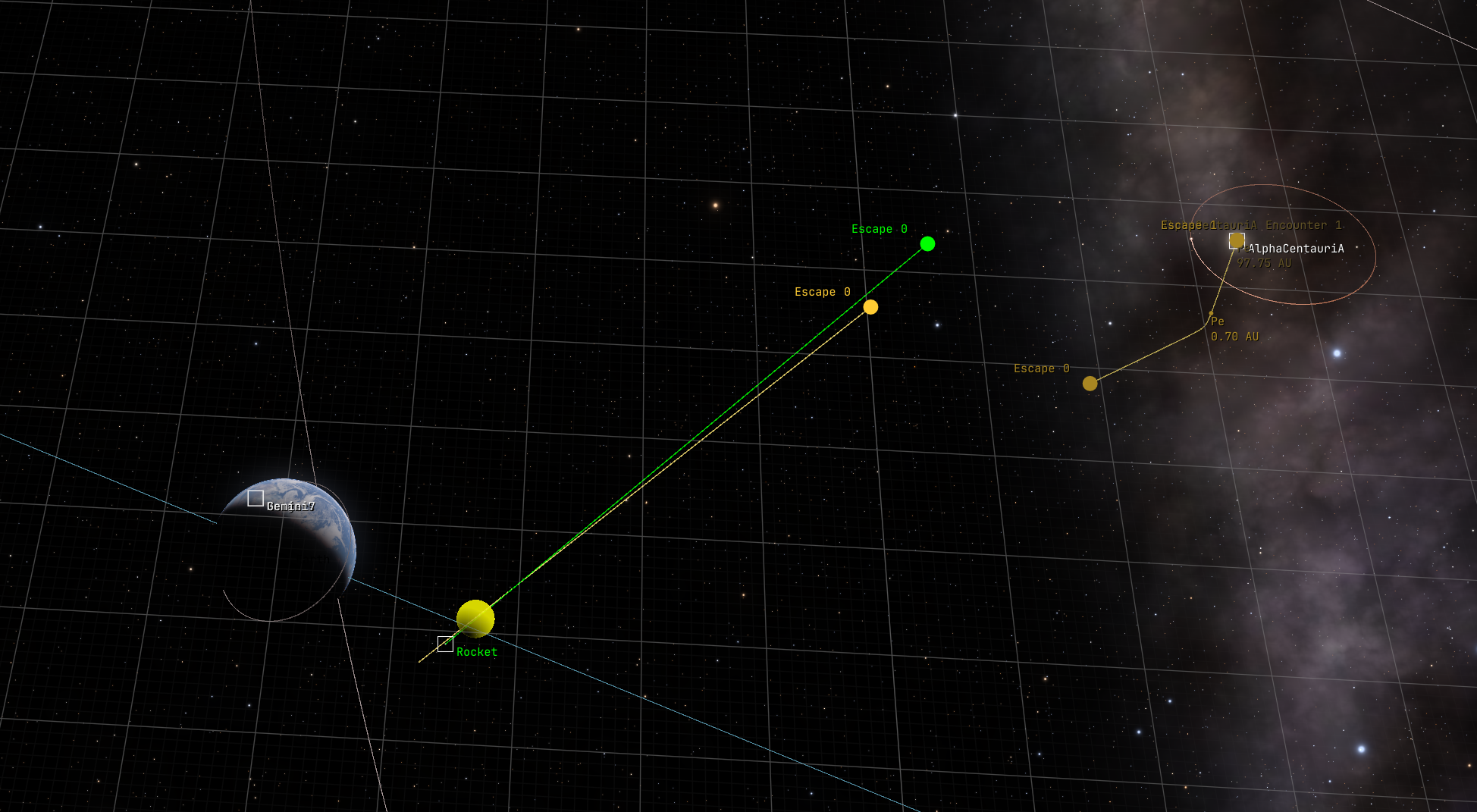
Inside a solar system KSA uses patched conics. Your ship follows one body's gravity at a time, and it hands over when it crosses a sphere of influence. Planets sit inside their star's sphere and moons sit inside their planet's.Stars don't fit that pattern. They don't orbit each other and no star is inside another's sphere.
Each star now owns every point that is closer to it than to any other star. Mathematicians call this a Voronoi partition. The boundary between two stars is the flat plane exactly halfway between them. Any trip that heads roughly towards another star will cross that plane, however far off-axis it is. The game and the flight planner use the same rule, so they always agree on which star you belong to.
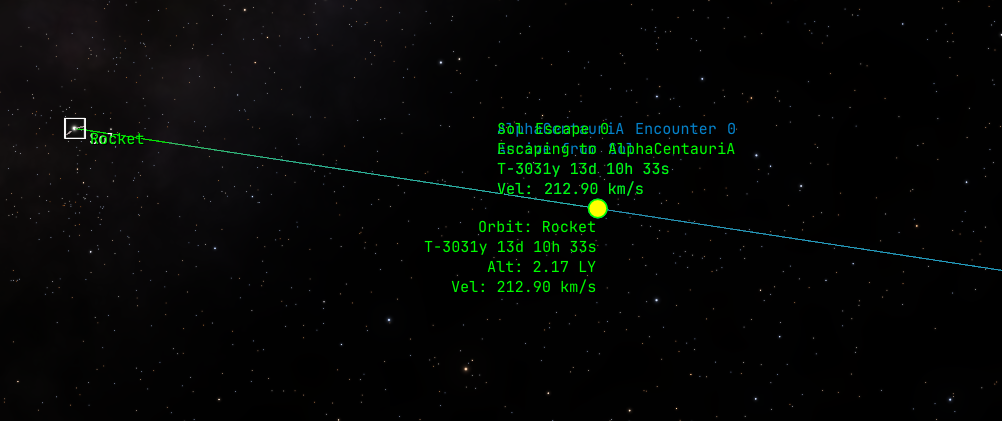
In the flight plan, the crossing shows up the same way a planetary encounter does: an Escape marker as you leave Sol, and an Encounter marker as you arrive at the next star.
Getting there: the FPD-1 Torch
Chemical rockets can't do this. Leaving low Earth orbit fast enough to reach Alpha Centauri in about a thousand years takes roughly 292 km/s of delta-v.Here is the mass ratio (full mass divided by empty mass) needed for that one burn:
Engine class Isp Mass ratio required for 292 km/s
Gas-core nuclear ~3,000 s ~18,500
Advanced 10,000 s ~20
Fusion torch 50,000 s ~1.8
So we built a fusion torch.
The FPD-1 Torch heats hydrogen to 3 million kelvin and pushes it out of an 8 m nozzle:
- Isp: 49,237 s (exhaust velocity about 483 km/s)
- Thrust: 38.6 MN
- Propellant: about 80 kg/s of liquid hydrogen
- Mass: 20 t
Watch your g-load
A ship with four Torches and not much else can pull tens of g. Manual throttle is now capped to keep the vehicle under its g-force limit. You'll see a "Throttle limited to stay under the g-force limit" notice on the HUD while that's happening. The Torch can also throttle down to 1%, so even a light ship can stay under its limit.Interstellar time warp
At 300 km/s, Alpha Centauri is about 4,300 years away. Standard warp maxes out at 7,776,000x, which would still be almost five hours of real world time.So there are new warp levels that only unlock between the stars:
Warp level Game time per real second
1 1 year
2 5 years
3 15 years
4 30 years
5 300 years
6 3,000 years
7 30,000 years
They become available once your flight plan has you on a star flight leg. Each level steps itself down before your next periapsis or star handover, so you won't overshoot your arrival.
Burns still happen at 30x warp or below, like everywhere else.
Planning the trip
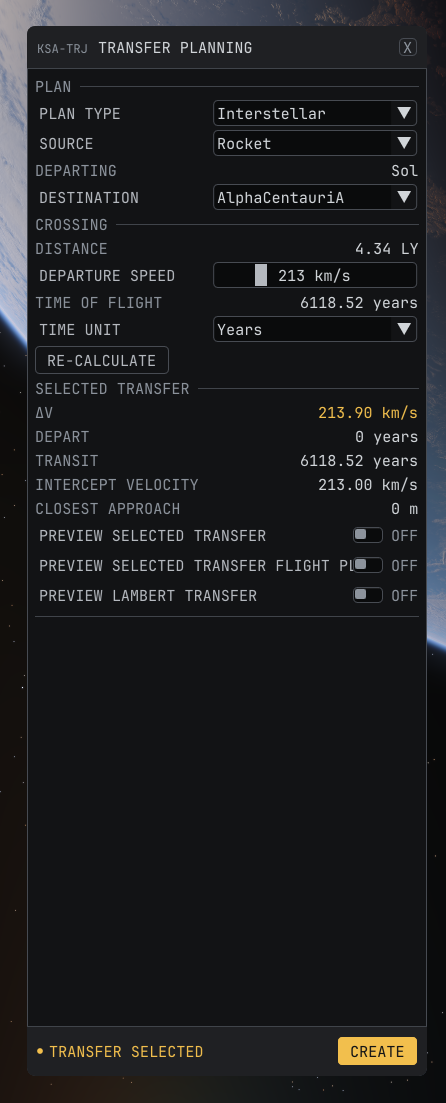
The Transfer Planner has a new plan type: Interstellar.A porkchop plot answers "when should I leave?", because planets move and there is a best launch window. Over a trip of a few thousand years, a star basically stays put. There's no window, so there's no porkchop. Instead you pick:
- Source: your vessel. The star you're leaving is whichever one you're at.
- Destination: another star.
- Departure speed: how fast you want to be going once you've escaped your star, from 1 to 1,000 km/s.
It also corrects your aim. The Sun bends your path on the way out, by about 15 degrees for a 50 km/s departure from Earth's distance.
The planner adjusts the burn so that you leave on the right heading. You will need to start from a body that orbits a star directly, such as Earth, not the Moon.
Known limits and what's next
This is a first pass, so here is what it doesn't do yet:- Bad performance at high timewarp. The game will perform very badly when using the new interstellar timewarp speeds if you have ANY other ships in the game.
- No arrival targeting. The planner gets you into the destination star's territory, heading the right way. It doesn't aim for a close pass by the star yet, so you'll need a correction burn on the way in to set up your capture.
- Long burns are treated as instant. The planner still models every burn as a single instant kick. A heavy ship on one Torch can burn for most of an orbit, swing its thrust round and drop its periapsis into Earth. More engines, or a lighter ship, keep the burn short. Proper finite-burn planning is on the list.
- One sun at a time. Each Star System can only have one star and only the nearest star lights the scene. Out at Alpha Centauri, the Sun delivers about a billionth of the light it does at Earth, so you wouldn't see it anyway. The catch is that Alpha Centauri B and Proxima Centauri don't count as light sources yet, so Proxima b and d are lit by Alpha Centauri A from about 13,000 AU away. That's effectively darkness, and solar panels there produce next to nothing.
- Placeholder art for the Torch engine.
- The throttle gauge shows what is being asked not what the engines get. The HUD message indicates this but the throttle gauge UI itself was left alone.
- Orbit and flight-plan lines are floats relative to their star. About 2 ly out that resolves to roughly 2×10⁹ m, so zoomed in close the line near the rocket sits in the wrong place.
Final notes:
This implementation was done to prove our Brutal engine and KSA architecture can achieve Interstellar travel simulation for the final game and this is pre-alpha, so there is still a lot to do to polish the Interstellar functionality.
As always, the UI and numbers shown here are by no means final.
Fly safe and pack a lot of hydrogen.
JPLRepo
Read on Ahwoo
Last edited:


