
Life Support: Air, Water, Food and a Clean Cabin
Kittens now need to breathe, drink and eat. Every seated kitten uses oxygen, water, meals and CO₂ scrubber canisters.
This is tier 1 of life support: everything is carried from launch and nothing is recycled yet. Recyclers, greenhouses and living off the land will come in later tiers.
Life support has been done plenty of times before in KSP mods and in other survival games, including our own Stationeers.
So before writing any code I did a lot of research going through what worked, what didn't, and what players said about it.
All that research told me that Life Support boils down to the following rules:
The rates, loadouts and UI shown here are by no means final. The numbers are real human ones for now and will get balanced once there's more to do on a long mission.
The water figure covers drinking (2.0 kg), food preparation (0.5 kg) and hygiene (0.7 kg).
Meals and scrubber canisters are Apollo and Gemini era: about 0.27 kg a meal, and LiOH canisters of 2.3 kg rated for 1.5 kitten-days each.
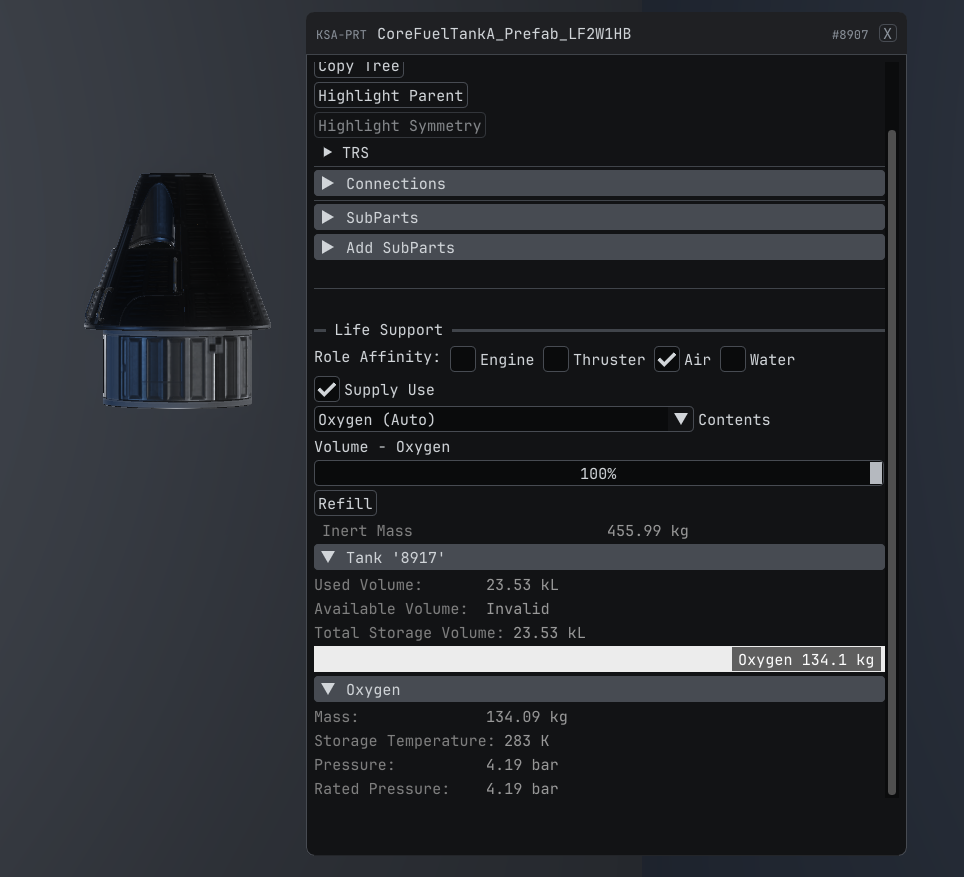
The capsule's small 0.175 m aluminium bottle holds 5.4 kg of oxygen at 203 bar. The part window shows each gas tank's pressure and rated pressure.
Want more air or water on your vehicle? Tick Air or Water under Role Affinity on any existing tank and it fills with oxygen or water. Air and Water each need a tank to themselves, so ticking one clears the other boxes. A tank that only the crew draw from shows Supply Use instead of Propellant Use.
The two crewed parts are loaded so all four supplies run out together after three days:
Older saves pick up the new supplies too. A capsule's new tanks load full in a save made before life support existed.
There's a new Life Support category in the editor's part picker with two supply lockers that fit into a service module's bays:
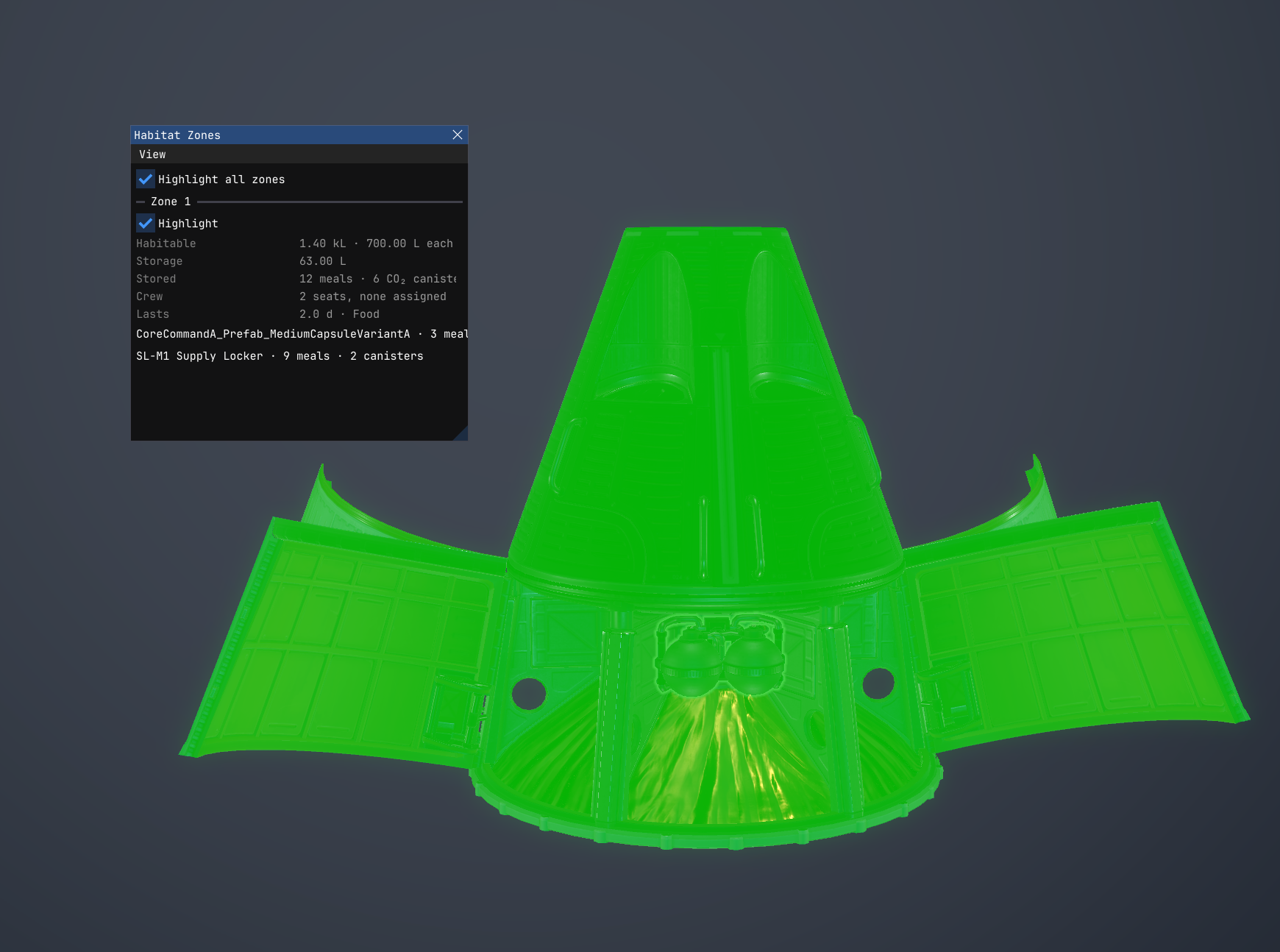
To make that work, every service module now has a habitat of its own. It stores nothing and adds no living space but kittens can pass through it. So a service module under a capsule joins the capsule's zone. A locker in its bays joins the same zone and its meals and canisters go into the crew's pantry.
The lockers borrow the bay tank models for now, so a locker and a bay tank look the same until they get models of their own.
PArts that have Habitats attached directly to each other form one zone. Put anything else between them and you have two zones with two separate pantries. Crew passages and service modules carry an empty habitat, so they join zones together.
Close them and the zone splits again. Hatches are closed by default and automatically close when you dock or undock and are persisted in save games.
Either one lists the empty seats in the kitten's zone including a docked vessel's seats through an open hatch. While the menu is open the kitten's current seat is marked in the world with a green dot and an arrow points to whichever seat you're hovering the mouse cursor over.
Crew portrait SEAT menu open, with the arrow from the current seat to the hovered oneKnowing how long you have
It shows in the same places delta-v already does, plus a few more:
As supplies run down the warnings escalate through four states:
The thresholds are fixed times rather than a percentage. I chose this because 10% sounds sensible until you notice it's 7 hours on a 3-day capsule but 73 days on a 2-year ship.
Alerts cover every crewed vessel not just the one you're flying. Vessels not being controlled by the player also consume life support resources and will run out too.
Consumption is linear. So a vessel's supplies are worked out in one step however long the warp step is and the warp step is cut short at the next warning or run-out.
Yes they will die, but it isn't instant.
From the moment a supply runs out each kitten climbs a ladder for that supply, with hours to weeks between the rungs:
The oxygen and CO₂ hours come from how fast cabin air goes bad: CO₂ above about 10% is fatal, and so is oxygen below about 10%. The table is for 2 m³ of cabin per kitten.
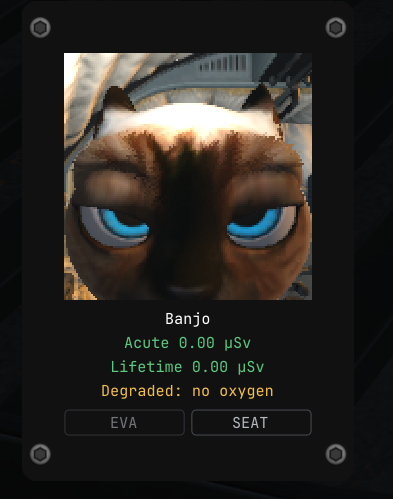
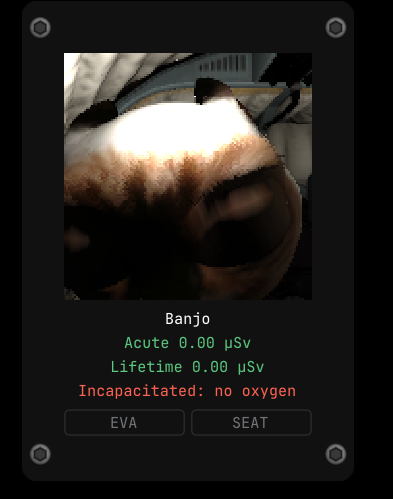
The hours scale with each zone's habitable volume so a cramped cabin goes bad faster, while water and food don't scale. The capsule gives its two kittens 0.7 m³ each so without oxygen they're degraded 1.2 hours after it runs out, incapacitated at 2.1 hours and dead at 3.2.
Every kitten keeps its own life support status and countdown clocks and takes them wherever it goes. It counts down against the zone's supplies for the zone that it is currently inside.
So one zone running dry doesn't hurt the kittens in the next zone.
Resupply stops the countdown clocks and the clock then runs back down at the rate it went up. A kitten on EVA recovers too, because the suit supplies everything, and so does a kitten back home. Only death is permanent.
Reaching a rung raises an alert, such as "Juquartz is incapacitated: no oxygen", and drops warp to 1×. Warp lands exactly on each rung so it can't carry you past one.
Hover a greyed-out control and it tells you why.
A vehicle with a probe core keeps flying the vessel so it doubles as a backup pilot.

A NASA Ames study (Jones, 2016) put numbers on it:
Recycling pays for itself after about 80 days. You'd want a spare system that far from home and every spare pushes the break-even out: about 180 days with two systems, 240 with three and 300 with four. Real programmes have moved along that curve:
Even the best loops leak. The ISS gets back 98% of its water since a brine processor was added in 2023, but only about half its oxygen, because the reactor that turns CO₂ back into water vents methane, and with it hydrogen.
Leaky loops are good for gameplay: a recycler buys you time but never makes a ship last forever.
Growing your own food closes the loop further but it's fragile. China's Lunar Palace 1 ran 370 days at 98.2% closure, with all of its oxygen and water and 73% of its food recycled. Biosphere 2 went the other way: oxygen fell below 14.5%, crops failed and the crew lost 16% of their body weight.
So KSA's tiers follow the real progression. Tier 1 is Apollo: carry it all. Each tier after that closes part of the loop and makes longer missions possible. Short trips will keep carrying everything, and long ones will need the hardware.
This is tier 1 of life support: everything is carried from launch and nothing is recycled yet. Recyclers, greenhouses and living off the land will come in later tiers.
Life support has been done plenty of times before in KSP mods and in other survival games, including our own Stationeers.
So before writing any code I did a lot of research going through what worked, what didn't, and what players said about it.
All that research told me that Life Support boils down to the following rules:
- Life support should be a limit on mission length and not a chore.
- Every failure should be explained and its cause on screen and available to the player.
- Penalties need a reward. Recyclers, greenhouses and living off the land are unlocks that make longer missions possible, not just add extra costs.
- Time warp and background simulation are the core problems in existing mods and games.
- Punishment versus planning. Life support is about planning, not punishment.
- More detailed life support simluation does not equal more gameplay depth.
- Fully closed loops remove the time pressure.
- Health, stress and habitation mechanics overlap.
- Forecasting and player information decides whether life support feels fair.
The rates, loadouts and UI shown here are by no means final. The numbers are real human ones for now and will get balanced once there's more to do on a long mission.
What a kitten needs
For now kittens use real human rates taken from NASA's Baseline Values and Assumptions Document (BVAD) for an 82 kg reference crew member. We can retune them later.| Supply | Per kitten per day | Where it's kept |
|---|---|---|
| Air (oxygen) | 0.895 kg | Tanks with the Air role |
| Water | 3.2 kg | Tanks with the Water role, drawn in 0.5 L units |
| Food | 3 meals, 0.8 kg | Habitat storage |
| CO₂ scrubbing | 1 canister per 1.5 kitten-days | Habitat storage |
Meals and scrubber canisters are Apollo and Gemini era: about 0.27 kg a meal, and LiOH canisters of 2.3 kg rated for 1.5 kitten-days each.
Oxygen is a gas now
Tanks can now hold gases, so oxygen is stored as high-pressure gas. A tank's rated pressure is worked out from its wall:shape, thickness and the wall material's strength at its storage temperature with a safety factor of 2.The capsule's small 0.175 m aluminium bottle holds 5.4 kg of oxygen at 203 bar. The part window shows each gas tank's pressure and rated pressure.
Want more air or water on your vehicle? Tick Air or Water under Role Affinity on any existing tank and it fills with oxygen or water. Air and Water each need a tank to themselves, so ticking one clears the other boxes. A tank that only the crew draw from shows Supply Use instead of Propellant Use.
Habitats
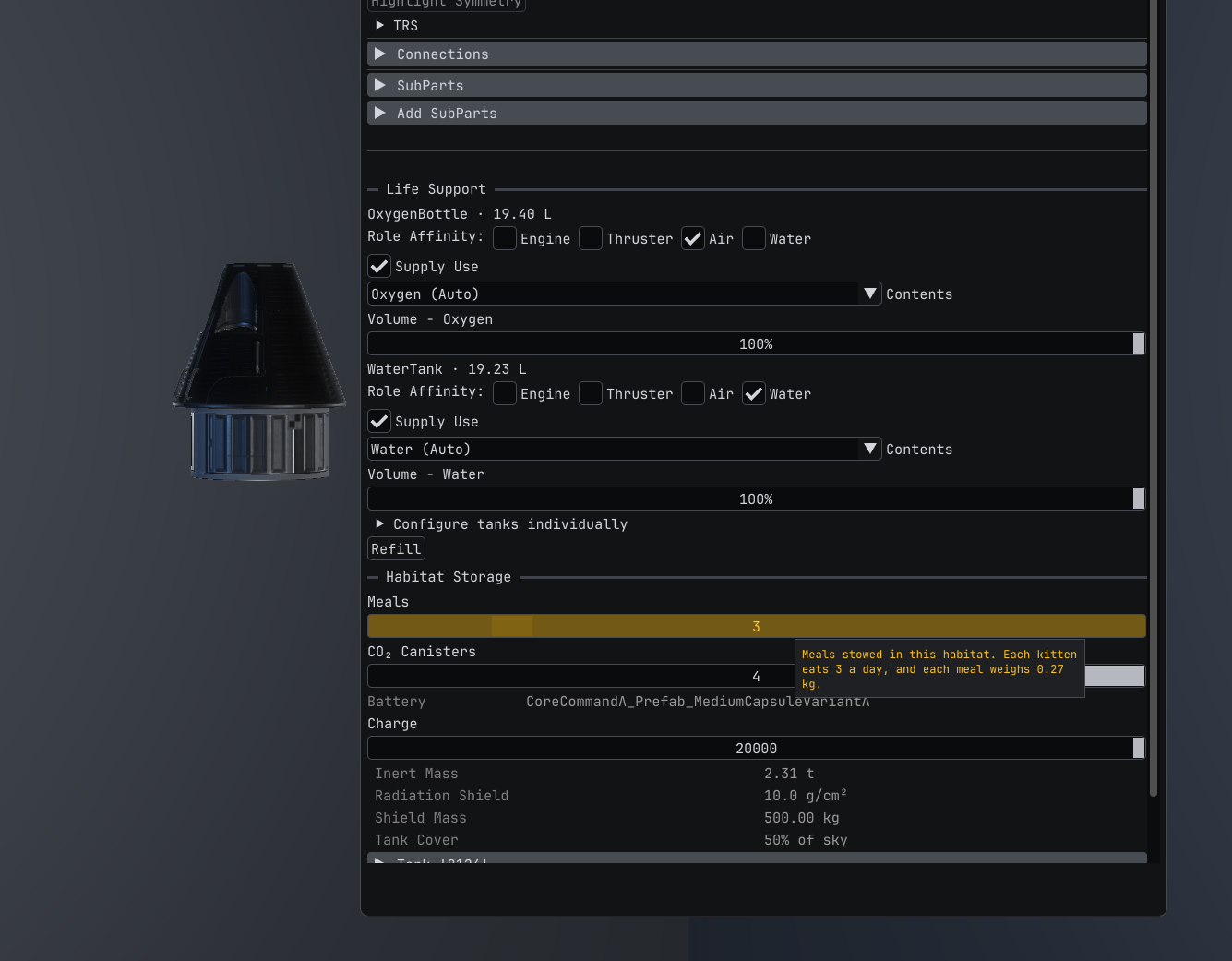
Any part kittens can sit in or move through now has a habitat. A habitat has a habitable volume which is the space the kittens live in and a storage volume where meals and scrubber canisters are stowed. That's how real spacecraft did it: Apollo had a LiOH locker in the cabin and the ISS keeps its food in bags.The two crewed parts are loaded so all four supplies run out together after three days:
| Part | Kittens | Cabin | Storage | Tanks | Lasts |
|---|---|---|---|---|---|
| Medium capsule | 2 | 1.4 m³ | 0.042 m³ 18 meals, 4 canisters | 5.4 kg O₂ 19.2 L water | 3 days |
| Lander Cans | 1 | 1.76 m³ | 0.021 m³ 9 meals, 2 canisters | Half the capsule's | 3 days |
Packing light
Select a crewed part in the editor and its part window has a Habitat Storage section with a Meals slider and a CO₂ Canisters slider, each from empty up to what the storage holds.
Carrying more: supply lockers
As mentioned a crewed part's storage can only store three days life support resources for the capsule's two kittens.There's a new Life Support category in the editor's part picker with two supply lockers that fit into a service module's bays:
| Part | Storage | Holds | For two kittens |
|---|---|---|---|
| SL-M1 Supply Locker | 0.021 m³ | 9 meals, 2 canisters | 1.5 days |
| SL-M2 Supply Locker | 0.105 m³ | 45 meals, 10 canisters | 7.5 days |
The lockers borrow the bay tank models for now, so a locker and a bay tank look the same until they get models of their own.
Zones and hatches
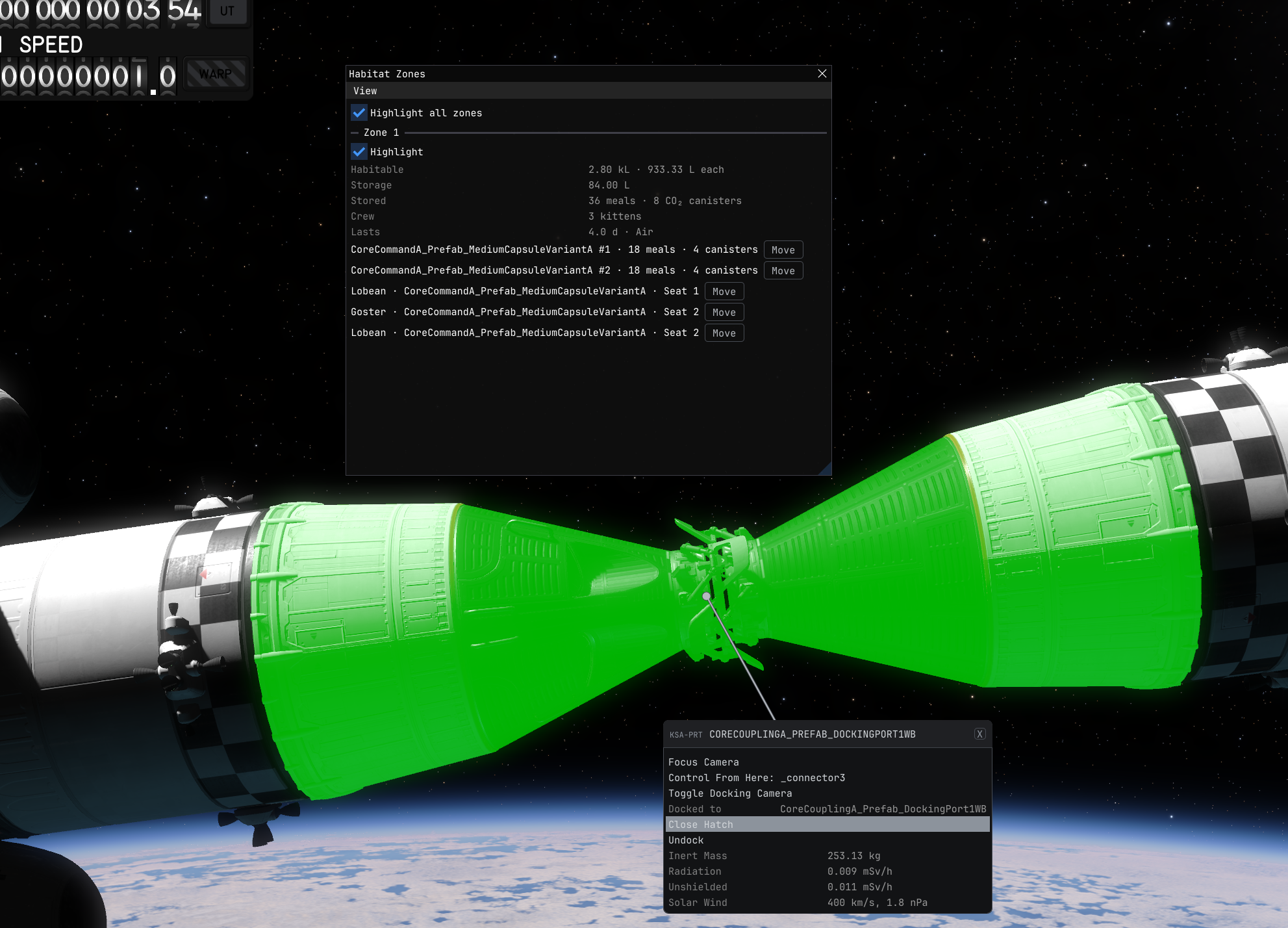
Life support doesn't run per vessel, it runs per habitat zone.PArts that have Habitats attached directly to each other form one zone. Put anything else between them and you have two zones with two separate pantries. Crew passages and service modules carry an empty habitat, so they join zones together.
- Food and scrubber canisters come from the zone's own habitats. One zone can't eat another zone's meals.
- Air and water come from any Air or Water tank the vessel's plumbing reaches, so zones on one vessel share tanks.
- Scrubbing is per zone, not per kitten. The zone's crew wears down the installed canister, and when it's spent a stowed one is swapped in.
Close them and the zone splits again. Hatches are closed by default and automatically close when you dock or undock and are persisted in save games.
Habitat Zones window
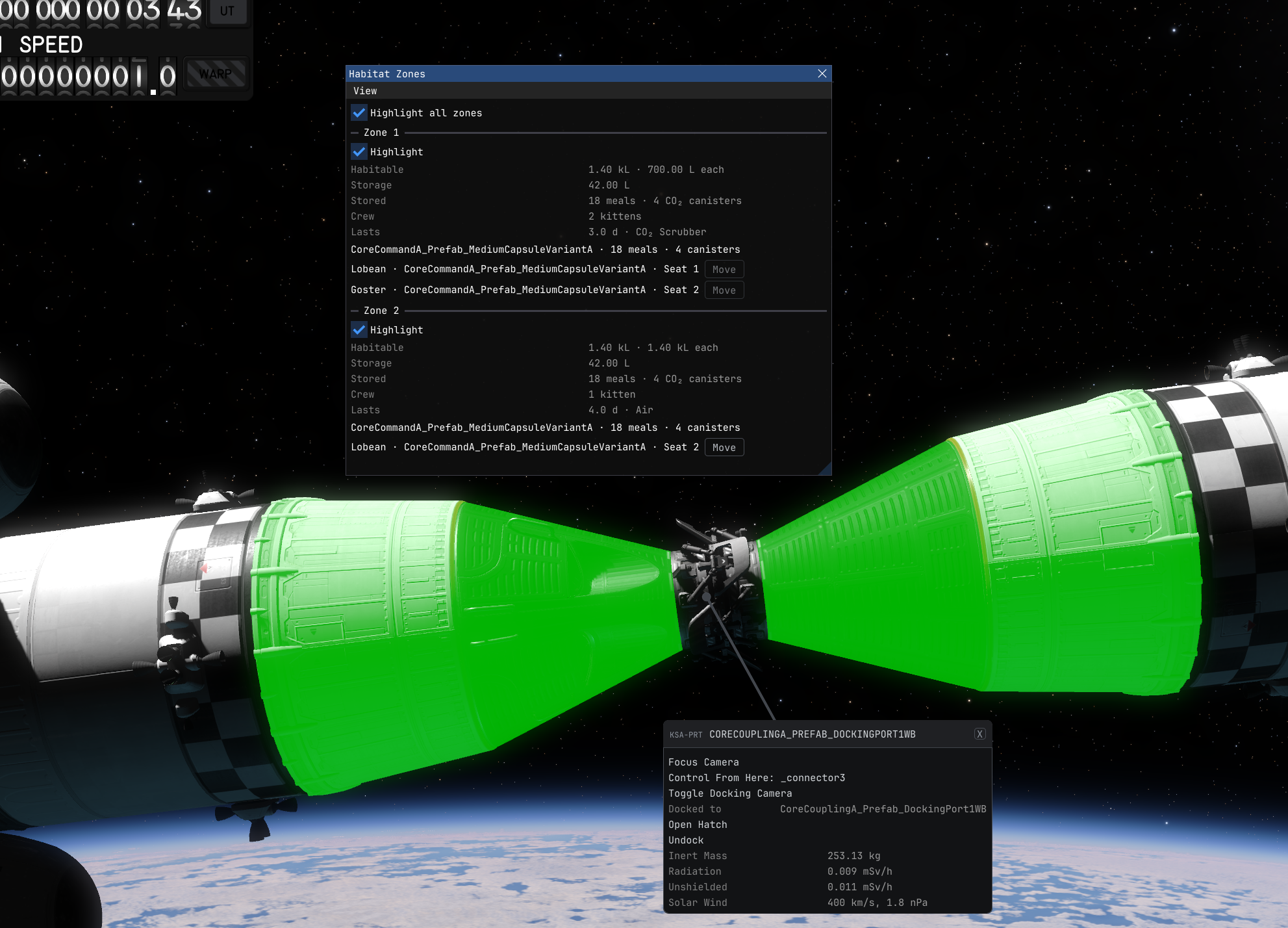
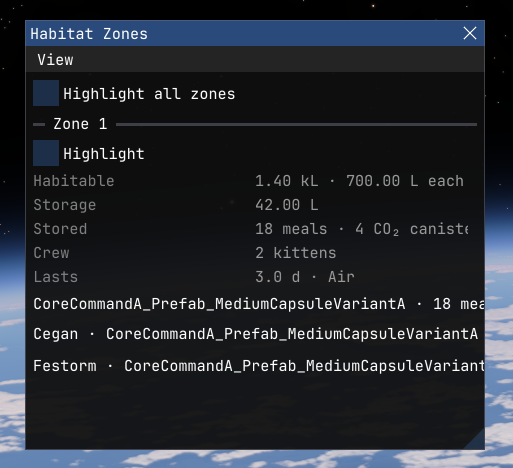
The new Habitat Zones window is available in the vehicle editor and flight. (shortcut Shift+F6). Each zone lists:- Total habitable volume and volume per kitten.
- Storage, meals and canisters.
- Which kittens are in it and how long its supplies last.
- A warning for a crewed zone with no storage, meals or canisters, so you catch it on the pad and not in orbit.
Moving between seats
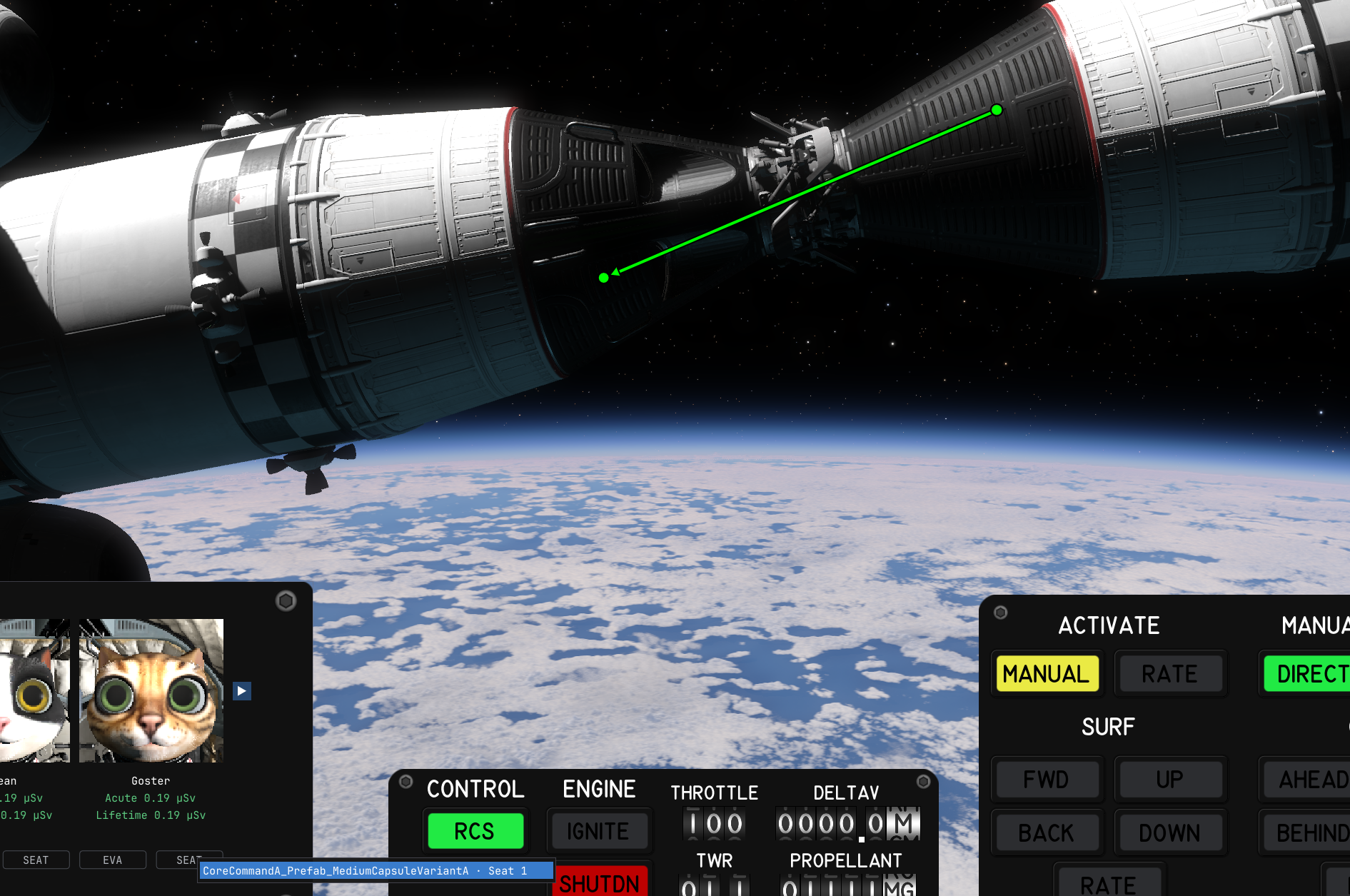
Until now a kitten could only change seats in flight by going out on EVA through one door and climbing back in through another. Now there's a SEAT button beside EVA on each crew portrait and a Move button beside each kitten in the Habitat Zones window.Either one lists the empty seats in the kitten's zone including a docked vessel's seats through an open hatch. While the menu is open the kitten's current seat is marked in the world with a green dot and an arrow points to whichever seat you're hovering the mouse cursor over.
Crew portrait SEAT menu open, with the arrow from the current seat to the hovered oneKnowing how long you have
Life support UI information
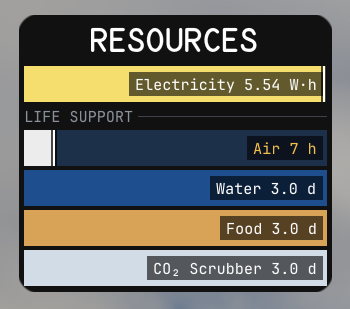
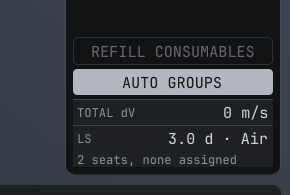
Life support reads as one line: days left and what runs out first.It shows in the same places delta-v already does, plus a few more:
- Editor: a LIFE SUPPORT row under TOTAL dV in the sequence footer with the crew it assumes underneath ("2 kittens assigned", or every seat filled when nobody is assigned yet).
- Resources gauge: four rows pinned under a LIFE SUPPORT divider, for Air, Water, Food and CO₂ Scrubber, with each how much time of each is left.
- Universe Manifest: a life support column so you can check vessels you aren't flying.
- Transfer Planner: a warning under the delta-v when the trip takes longer than your supplies last.
- Part window: a crewed part shows its zone the kittens in it and the time left for each supply.
As supplies run down the warnings escalate through four states:
| State | When | What happens |
|---|---|---|
| OK | More than 1 day left | Nothing |
| Low | 1 day left | Alert, warp drops to 1×, and a "Life support low" line while you're flying that vessel |
| Critical | 1 hour left | Alert, warp drops to 1× again |
| Out | A supply runs out | Alert, warp stops |
Alerts cover every crewed vessel not just the one you're flying. Vessels not being controlled by the player also consume life support resources and will run out too.
Consumption is linear. So a vessel's supplies are worked out in one step however long the warp step is and the warp step is cut short at the next warning or run-out.
What about performance? I hear people saying
It's also cheap. With 121 crewed vessels in orbit the stress test for all of them costs about 0.06 ms of main thread a frame and frame time and sim rate didn't change measurably.What happens when we runs out?
Yes, kittens will DIE and there's no setting to turn it off. IT is expected once we start building game modes and difficulty settings that a lot of these settings and options will be introduced then.Yes they will die, but it isn't instant.
From the moment a supply runs out each kitten climbs a ladder for that supply, with hours to weeks between the rungs:
| Rung | No oxygen | No CO₂ scrubber | No water | No food | Effect on the kitten |
|---|---|---|---|---|---|
| Degraded | 3.5 h | 2.5 h | 1 day | 14 days | Refuses to go on EVA |
| Incapacitated | 6 h | 5.5 h | 3 days | 30 days | Can't move seats. If every kitten aboard is incapacitated and there's no probe core, the vessel can't be flown |
| Death | 9 h | 8 h | 7 days | 45 days | Dies, with an alert naming what ran out |
The hours scale with each zone's habitable volume so a cramped cabin goes bad faster, while water and food don't scale. The capsule gives its two kittens 0.7 m³ each so without oxygen they're degraded 1.2 hours after it runs out, incapacitated at 2.1 hours and dead at 3.2.
Every kitten keeps its own life support status and countdown clocks and takes them wherever it goes. It counts down against the zone's supplies for the zone that it is currently inside.
So one zone running dry doesn't hurt the kittens in the next zone.
Resupply stops the countdown clocks and the clock then runs back down at the rate it went up. A kitten on EVA recovers too, because the suit supplies everything, and so does a kitten back home. Only death is permanent.
Reaching a rung raises an alert, such as "Juquartz is incapacitated: no oxygen", and drops warp to 1×. Warp lands exactly on each rung so it can't carry you past one.
Losing control
A crewed pod needs someone awake to fly it. When every kitten aboard is incapacitated, manual controls, staging, engines and burns lock out, and an alert says the vessel is out of control.Hover a greyed-out control and it tells you why.
A vehicle with a probe core keeps flying the vessel so it doubles as a backup pilot.
Seeing how each kitten is doing
- Crew portrait: now has a line under the radiation doses, "Degraded: no oxygen" in amber or "Incapacitated: no CO₂ scrubber" in red. Hover it for each supply's clock: "No oxygen for 4h, incapacitated in 2h", or after resupply "Has oxygen again, recovered in 3h".
- Kitten Roster: now has a Condition column with the same text and tooltip so you can check kittens on vessels you aren't flying.
- Memorial tab: now has a Cause of Death column for every way a kitten can die: no oxygen, CO₂ scrubber, water or food, radiation, a ground or ocean impact, a collision, g-force, aerodynamic or hydrodynamic forces, a fall on EVA, or an abandoned vessel. It's saved with the game. Kittens lost before this update show it blank.
Carry it or recycle it
Real spacecraft either carry everything they need (an open loop) or recycle some of it (a closed loop). Apollo carried everything. The ISS recycles air and water but still gets its food from cargo ships. Which one makes sense comes down to mission length.A NASA Ames study (Jones, 2016) put numbers on it:
| Approach | Mass |
|---|---|
| Carry everything | ~9.3 kg per crew-day |
| ISS-style recycling | ~730 kg up front + 0.2 kg per crew-day |
| Programme | Approach |
|---|---|
| Apollo | Fully open: everything carried |
| ISS | Air and water partly closed, food carried, cargo resupply |
| Gateway | Mostly open, for 30-day crew stays |
| Mars transit | Closed, and it has to survive a year with no crew aboard |
Leaky loops are good for gameplay: a recycler buys you time but never makes a ship last forever.
Growing your own food closes the loop further but it's fragile. China's Lunar Palace 1 ran 370 days at 98.2% closure, with all of its oxygen and water and 73% of its food recycled. Biosphere 2 went the other way: oxygen fell below 14.5%, crops failed and the crew lost 16% of their body weight.
So KSA's tiers follow the real progression. Tier 1 is Apollo: carry it all. Each tier after that closes part of the loop and makes longer missions possible. Short trips will keep carrying everything, and long ones will need the hardware.
What's next
| Next | What it adds | Waiting on |
|---|---|---|
| Supply transfer | Move meals and canisters between habitats, and across an open hatch to a docked vessel. Moving gas between tanks for docking resupply | Tier 1 finished |
| Tier 2: recycling | Regenerable CO₂ scrubbers that run on power, and water recovery at rising rates. Losing power starts to matter for air | Power design |
| Tier 3: oxygen | Oxygen from electrolysis and CO₂ reduction | Tier 2 |
| Tier 4: greenhouses | Grow part of your food, at a high power and light cost | Tier 3 |
| Tier 5: ISRU | Water from ice, oxygen from CO₂ atmospheres, using what's on the ground | Tier 4 |
| Locker models | Proper models for the supply lockers in place of the borrowed bay tanks | Art |
| Living space | Cabin volume per kitten as a comfort level. Cramped kittens work slower, comfortable ones a bit faster. It's a modifier, never a death timer. | Science and repair to affect |
| Modding | Rates, meal and canister sizes and the ladder moved into content data, so mods can make life support gentler or harsher | Tier 1 finished. Most likely ends up as difficulty settings |
Enjoyed this update?
Support the team behind Kitten Space Agency to keep updates like this coming.


