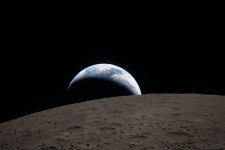
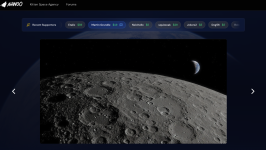
images from artemis II vs ahwoo wow

Looks like the moon needs to be a little bit of a "warmer" color in KSA.
Also, any thought towards choosing focal lengths of the in game camera's?
 
I think it should as realistic as possible, and it looks not bad; moon color is dark grey, it only appears white in direct sunlight.

Astronauts on Artemis II described more color variation(s) than simply dark grey. It is possible that the white balance was not set properly on the camera (which I doubt) but the image above (to me) shows a slightly warmer, almost brown hue that differs from the standard views of the moon that have been common thus far. It can be seen in the lunar flyby images in the NASA link below.
The warm hue is subtle but present.

https://www.nasa.gov/gallery/lunar-flyby/

"The astronauts reported some intriguing things, such as patches of green and brown on the lunar surface.

"We do know there is color on the lunar surface," Osinski said. The human eye, he added, is more sensitive to color than the cameras on board Artemis II, so "that's definitely going to be something interesting to follow up.""
https://www.livescience.com/space/t...cited-about-artemis-iis-historic-lunar-photos
 
  • Like
Reactions: Courier and Tom4K
Astronauts on Artemis II described more color variation(s) than simply dark grey. It is possible that the white balance was not set properly on the camera (which I doubt) but the image above (to me) shows a slightly warmer, almost brown hue that differs from the standard views of the moon that have been common thus far. It can be seen in the lunar flyby images in the NASA link below.
The warm hue is subtle but present.

https://www.nasa.gov/gallery/lunar-flyby/

"The astronauts reported some intriguing things, such as patches of green and brown on the lunar surface.

"We do know there is color on the lunar surface," Osinski said. The human eye, he added, is more sensitive to color than the cameras on board Artemis II, so "that's definitely going to be something interesting to follow up.""
https://www.livescience.com/space/t...cited-about-artemis-iis-historic-lunar-photos
I would define the “color” of an object as its reflected color spectrum under ideal white light (spectral power density constant across the frequency spectrum).
How one then perceives the color is another question.
Of course, the most realistic approach would be to model this perception in the simulation using the sun’s radiation and frequency spectrum (which, for example, has some gaps in the frequency spectrum) as well as the effects within the eye (analogous to the glare of the sun, for example).
A real challenge for computer graphics artists!
 
  • Like
Reactions: Courier